System Shaping is a framework for understanding why organizations resist change, why transformation efforts often fail, and how real organizational transformation happens in complex human systems.
Most organizations do not fail to change because people are lazy, irrational, or naturally resistant. They fail because the system has learned how to protect its current way of surviving. It protects familiar roles, familiar incentives, familiar conflicts, familiar identities, and familiar explanations.
Even when everyone agrees that change is needed, the deeper system often continues to reproduce the same pattern.
System Shaping begins with one central idea: you cannot transform an organization by correcting only its visible behavior. You have to understand the hidden pattern that keeps recreating that behavior.
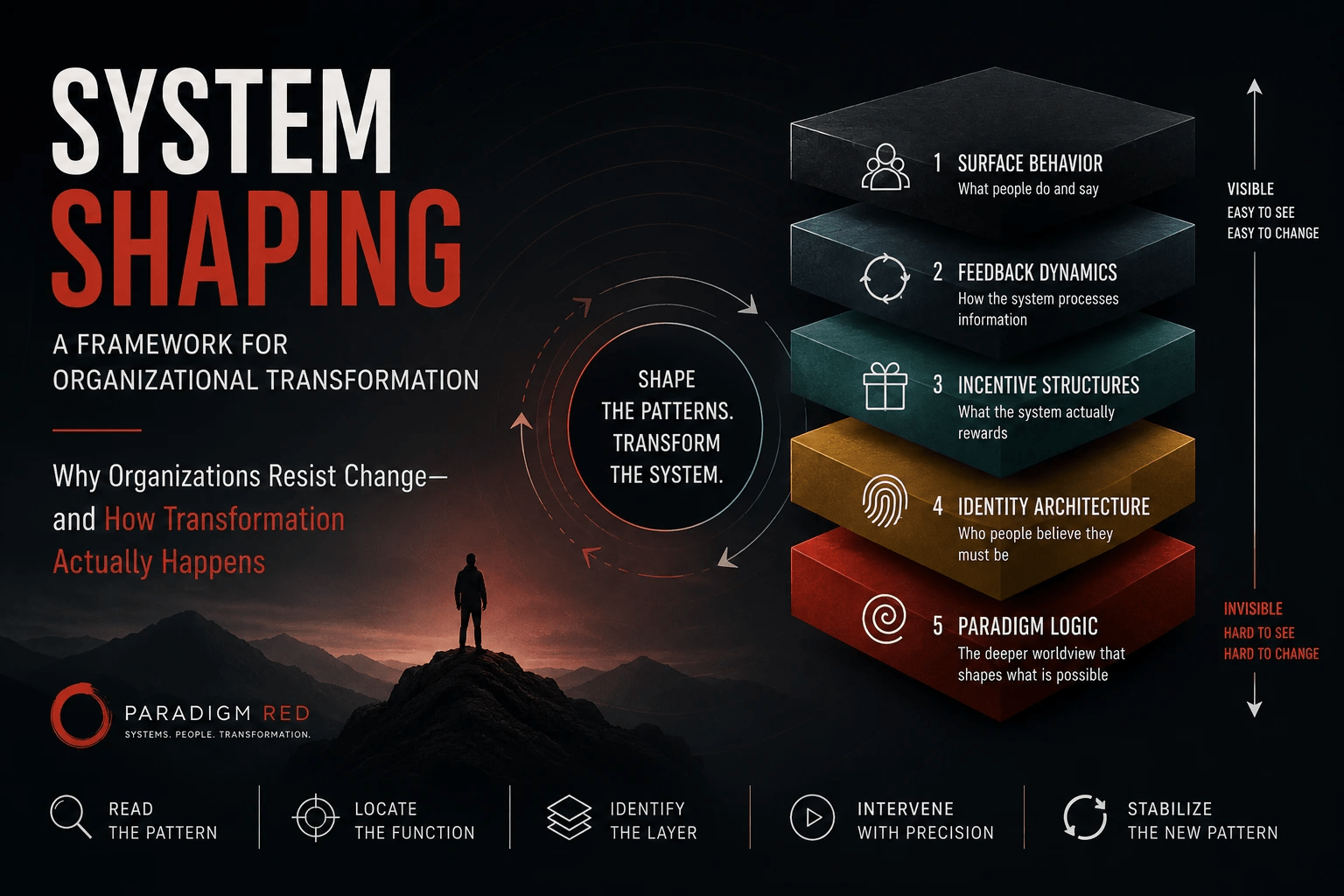
The System Shaping Framework in One Sentence
System Shaping is the practice of reading, influencing, and evolving the deeper patterns that guide how a human system makes decisions, handles pressure, distributes power, interprets feedback, and protects its identity.
- Core problem: organizations repeat patterns that once helped them survive.
- Core question: what keeps this system recreating the same result?
- Core method: intervene at the layer where the real pattern is organized.
- Core outcome: transformation becomes structurally possible, not merely rhetorically desired.
Why Existing Change Models Are Breaking Down
Traditional change language was built for a more predictable world. It assumes that if leaders define the future, communicate clearly, align stakeholders, and manage implementation, the organization will move toward the new state.
Sometimes that works. But in complex human systems, it often does not.
Organizations today face AI disruption, exhaustion, hybrid work, institutional distrust, cultural fragmentation, and constant uncertainty. A linear plan may create temporary order, but it often fails to touch the deeper dynamics that actually control behavior.
This is why many transformation programs begin with energy and end in fatigue. The roadmap looks serious. The values are updated. The workshops happen. The language changes. But after a few months, the organization quietly returns to its old center of gravity.
For a deeper foundation, read Why Organizational Change Fails and Why People Resist Change.
Resistance is often not opposition to change. It is the system protecting the logic that once helped it survive.
From Systems Thinking to System Shaping
Systems thinking helps us see patterns instead of isolated events. It teaches us to notice feedback loops, delays, incentives, relationships, unintended consequences, and hidden dependencies.
That is essential. But seeing the system is not the same as changing it.
Many leaders learn to map systems and still do not know where to act. Many coaches become skilled at noticing patterns but hesitate when the system requires a real intervention. Many consultants diagnose complexity accurately, then return to linear tools because they do not have a deeper practice of systemic influence.
System Shaping begins where observation becomes intervention.
It asks:
- What pattern is this system repeating?
- What function does that pattern serve?
- What does the system gain by staying the same?
- Where does feedback get blocked, distorted, or punished?
- Which layer of the system is actually asking for intervention?
- What small shift could change the behavior of the whole pattern?
The Five Layers of System Shaping
Most failed transformation efforts operate at the wrong layer. They try to fix behavior when the real issue is identity. They redesign process when the real issue is trust. They demand accountability when the real issue is fear. They introduce values when the real issue is incentives.
The System Shaping framework uses five practical layers.
Surface Behavior
What people do, say, avoid, repeat, delay, escalate, or perform in daily work.
Feedback Dynamics
How the system receives, distorts, ignores, punishes, or learns from information.
Incentive Structures
What the system actually rewards, even when official values say something else.
Identity Architecture
Who people believe they must be in order to belong, succeed, or stay safe.
Paradigm Logic
The deeper worldview that defines what the system considers normal, possible, and legitimate.
The System Shaping Model
A system is shaped by moving through five diagnostic and intervention movements. This sequence prevents leaders and coaches from jumping too quickly into solutions before understanding what the system is actually protecting.
Read the pattern. Notice what keeps repeating across meetings, decisions, conflicts, delays, and leadership behavior.
Locate the protective function. Ask what the repeated pattern protects: status, speed, belonging, predictability, control, or emotional safety.
Identify the real layer. Decide whether the issue is behavioral, informational, structural, identity-based, or paradigmatic.
Introduce a precise disruption. Change the loop, not only the symptom. This may involve feedback, incentives, decision rules, leadership behavior, or language.
Stabilize the new pattern. Transformation is real only when the new pattern survives pressure.
Layer 1: Surface Behavior
Surface behavior is what most people notice first: missed deadlines, defensive meetings, poor collaboration, slow decisions, burnout, conflict avoidance, over-control, passive resistance, or endless discussion without movement.
This layer matters. Behavior is real. But behavior is rarely the root.
If a team avoids honest conversations, the visible issue may look like poor communication. But the deeper pattern may be fear of punishment, lack of trust, status protection, or a history of leaders reacting badly to bad news.
When we intervene only at the behavioral layer, we often create temporary compliance. People learn the new language. They attend the workshop. They repeat the desired phrases. But the old system remains intact underneath.
Layer 2: Feedback Dynamics
Every system has a relationship with feedback.
Some systems welcome feedback early, when it is still useful. Others only accept feedback after damage becomes impossible to deny. Some systems ask for feedback but punish the people who provide it. Some systems collect feedback endlessly but never metabolize it into action.
This matters because feedback is how a system learns. When feedback is blocked, the system becomes self-protective. It starts defending its self-image instead of updating its behavior.
Related reading: Why Organizations Become Immune to Feedback.
Layer 3: Incentive Structures
Official values are often less powerful than hidden rewards.
A company may say it values collaboration but promote the person who protects their own department. It may say it values innovation but punish failed experiments. It may say it values quality but reward speed at any cost. It may say it wants long-term thinking but measure only short-term output.
People learn the real rules quickly.
System Shaping pays close attention to the gap between declared values and rewarded behavior. That gap is one of the most important diagnostic signals in any organization.
Layer 4: Identity Architecture
Organizations do not only have processes. They have identities.
A team may see itself as heroic firefighters. A founder-led company may see itself as fast, instinctive, and anti-bureaucratic. A senior leadership group may see itself as the only group mature enough to make real decisions. A department may define itself through being underappreciated, misunderstood, or always overloaded.
These identities are powerful because they give meaning to behavior.
If a team identifies as “the people who always save the organization at the last minute,” then preventing crises may feel strangely threatening. Without the crisis, who are they?
System Shaping asks: what new identity could allow the system to evolve without experiencing evolution as humiliation?
Layer 5: Paradigm Logic
The deepest layer is paradigm logic.
This is the hidden worldview that tells the system what is real, what matters, what counts as success, what kind of leadership is legitimate, and what kind of change feels acceptable.
This is where Spiral Dynamics becomes especially useful. Different value systems interpret the same organizational problem differently. A control-driven system may see decentralization as chaos. A performance-driven system may see reflection as inefficiency. A consensus-driven system may see conflict as danger. A systemic organization may see conflict as information.
Paradigm logic shapes what the system can even recognize.
This is why the same intervention can work in one organization and fail completely in another. The tool is not the whole story. The developmental logic of the system determines how the tool is interpreted.
Why Organizations “Resist” Change
The phrase “resistance to change” is often too shallow.
It makes the problem sound like people are simply unwilling. But in many cases, resistance is not refusal. It is information.
Resistance may reveal:
- a loss of trust after previous failed initiatives
- a contradiction between words and incentives
- a threat to identity or status
- unprocessed fatigue from constant change
- a hidden fear that leaders are not naming
- a real flaw in the proposed transformation
- a deeper paradigm conflict inside the organization
Do not ask only, “How do we overcome resistance?” Ask, “What is this resistance protecting, revealing, or trying to stabilize?”
System Shaping vs. Change Management
Change management often focuses on planning, communication, adoption, stakeholder alignment, training, and implementation. These are useful. System Shaping does not reject them.
But System Shaping starts earlier and goes deeper.
It asks whether the system is structurally capable of receiving the change. It asks whether the change contradicts existing incentives. It asks whether leaders are trying to transform the organization while remaining unchanged themselves. It asks whether the system is asking for a technical solution when the real issue is trust, power, meaning, or paradigm conflict.
Change management often asks: “How do we implement this change?”
System Shaping asks: “What must become true in the system for this change to become natural?”
System Shaping and Leadership
Leadership in System Shaping is not heroic control. It is not charisma. It is not the ability to force movement through pressure.
Leadership becomes the ability to sense what the system is becoming ready to face.
A System Shaping leader learns to ask better questions:
- What are we pretending not to know?
- What does our system reward that our values deny?
- Where are we performing alignment instead of building coherence?
- What feedback do we claim to want but quietly reject?
- Which part of our identity is preventing the next stage of growth?
- What would become easier if we stopped protecting the old pattern?
The leader is not outside the system. The leader is one of the system’s strongest signals.
System Shaping and Coaching
Systemic coaching often begins with individuals but cannot end there.
A person may want to behave differently, but the system around them may keep pulling them back into the old role. A manager may want to lead more openly, but the executive culture may reward certainty and punish vulnerability. A team may want better collaboration, but the organization’s incentive structure may continue to reward internal competition.
This is the danger explored in The Coaching Paradox: helping the individual can sometimes leave the system untouched.
System Shaping gives coaches a broader lens. It asks not only, “What does this person need to understand?” but also, “What system keeps making this person necessary in this role?”
False Harmony: A Common Transformation Blocker
One of the most dangerous patterns in organizations is false harmony.
False harmony appears when people avoid conflict in order to preserve the appearance of unity. Meetings feel polite. Language becomes careful. Disagreement moves into private conversations. Real tension does not disappear; it goes underground.
This is especially dangerous because it can look healthy from the outside. Leaders may believe the organization is aligned because nobody openly disagrees. But silence is not alignment. Calm is not trust. Politeness is not coherence.
Read more: False Harmony.
The Control Delusion
Another common blocker is the belief that complex systems can be controlled through enough planning, reporting, and pressure.
Control feels responsible. It creates visible activity. It produces dashboards, meetings, escalation paths, and performance language. But in complex human systems, excessive control often reduces intelligence. People stop sensing and start complying. They stop surfacing weak signals and start managing impressions.
The result is a system that looks more organized but becomes less adaptive.
Related: The Control Delusion.
What Transformation Actually Requires
Transformation is not the moment when an organization announces a new direction.
Transformation happens when the system can no longer reproduce its old pattern in the same way.
That requires more than motivation. It requires a shift in how the system perceives, rewards, decides, relates, and explains itself.
Real transformation often includes:
- a new language for naming old patterns
- a safer relationship with feedback
- visible changes in leadership behavior
- incentives that match declared values
- new rituals that stabilize new behavior
- the courage to face conflict without collapsing into blame
- a deeper identity that can hold the next stage of complexity
Why System Shaping Matters Now
Organizations today operate under pressure that older management models were not designed to handle. Rapid technological change, AI disruption, social fragmentation, burnout, hybrid work, institutional distrust, and constant uncertainty all expose the limits of purely linear transformation methods.
System Shaping matters because it gives leaders, coaches, consultants, and transformation professionals a way to work with complexity without becoming vague.
It gives language to the hidden forces that usually remain unnamed: identity, feedback, incentives, paradigm logic, and recursive patterns.
It helps organizations stop asking only, “What should we change?” and start asking the deeper question:
What kind of system are we continuously becoming through the patterns we keep rewarding?
Start the System Shaping Path
To understand the framework step by step, continue through this sequence:
How to Read a System → Where to Intervene → Recursive Superinterception → Systems Transformation
System Shaping Resources
Explore practical System Shaping frameworks, diagnostics, and transformation tools designed for leaders, systemic coaches, consultants, and organizations working inside complex human systems.
- The System Shaping Diagnostic — a practical framework for reading organizational patterns, resistance, leadership blindspots, and systemic transformation.
- Download the full PDF on Patreon
FAQ: System Shaping
What is System Shaping?
System Shaping is a framework for understanding and influencing the deeper patterns that guide how organizations behave, resist change, process feedback, and evolve.
How is System Shaping different from systems thinking?
Systems thinking helps you see patterns. System Shaping focuses on how to intervene in those patterns so transformation can actually happen.
Why do organizations resist change?
Organizations often resist change because existing patterns protect identity, power, stability, incentives, or familiar ways of working. Resistance is usually diagnostic information, not just opposition.
Who is System Shaping for?
System Shaping is for leaders, systemic coaches, consultants, founders, and transformation professionals working with complex human systems.
Can System Shaping be used with Spiral Dynamics?
Yes. Spiral Dynamics helps identify the value-system logic inside an organization. System Shaping uses that insight to understand what kind of transformation the system can actually metabolize.