Practical transformation governance
A transformation management office charter defines the TMO’s approved purpose, scope, decision authority, responsibilities, resources, and success measures. It makes clear what the office can do, what remains with the business, and how unresolved issues reach someone empowered to decide.
This guide provides a copyable charter template, a completed example, an authority matrix, and an approval checklist. The aim is a mandate people can use when priorities conflict, not another document that leaves the hard decisions unspecified.
Jump to the charter template
What is a transformation management office charter?
A transformation management office charter records the office’s approved mandate: why it exists, where it operates, which decisions it can make, what resources it can use, and how its contribution will be assessed. It also identifies responsibilities that remain with executive sponsors, delivery teams, and operational leaders.
A TMO charter and a transformation charter have different scopes in this guide. The transformation charter defines the broader change ambition, boundaries, and intended outcomes; the TMO charter authorizes the office’s role in supporting them. Organizations may combine both documents, but the office’s mandate and delegated limits should remain explicit.
The charter is useful when establishing a TMO, expanding a PMO’s mandate, or correcting recurring disputes about ownership and authority. If you need the broader definition, structure, and operating framework, start with the Transformation Management Office guide.
The document records delegated authority; it does not create powers that the appropriate organizational authority has never approved. “Coordinate transformation” is insufficient if nobody has agreed who can resolve a capacity conflict or stop work that no longer supports the strategy.
- A project charter concerns a particular project; a TMO charter defines the office’s mandate across its specified transformation scope.
- A business case explains the justification for investment; the charter establishes responsibilities and authority for the office.
- An operating model explains how the work runs. The charter defines what that model must support. Use the transformation operating model guide for that broader design.
Transformation management office charter template
Copy the following template into your working document and replace every bracketed field. It is a practical starting format, not a universal standard. Keep detailed authority matrices and operating procedures in referenced appendices when that makes the core charter easier to use.

Copyable TMO charter
1. Document control and approval
Owner: [role]. Version: [number]. Effective date: [date]. Review date: [date]. Approving authority: [role/body]. Record the approval and any conditions that must be met before work begins.
2. Purpose and strategic outcomes
The TMO exists to [specific purpose]. It supports [outcomes] by changing [organizational conditions]. Success means [observable results], while protecting [quality, service, or other guardrails].
3. Scope and exclusions
Included: [business units, initiatives, processes, and interfaces]. Excluded: [work outside the mandate]. Scope changes require [authorized decision-maker].
4. Sponsor and reporting relationship
Executive sponsor: [role]. The TMO reports to [role/body]. Cross-functional conflicts go to [authorized forum]. Name a fallback route if the primary decision-maker is unavailable.
5. Decision rights and limits
The TMO may decide [specific decisions] within [limits]. Reserved decisions are [list], owned by [roles/bodies]. State the evidence, consultation, and record required for each decision type.
6. Responsibilities and reciprocal obligations
The TMO is responsible for [services and coordination]. Participating functions must provide [information, decisions, and commitments]. Initiative leaders retain [delivery responsibilities].
7. Adoption and benefits ownership
Business outcome owner: [role]. This owner is accountable for [operating changes, adoption, and benefits]. The TMO supports [evidence, coordination, and escalation]; it does not silently inherit operational accountability.
8. Resources and information access
Committed staffing and time: [roles, allocations, dates, and approving managers]. Funding: [approved envelope and restrictions]. Access: [data, systems, and permissions]. Record unresolved resource conditions explicitly.
9. Governance cadence and interfaces
Forums: [purpose, attendees, authority, and frequency]. Decision inputs: [minimum evidence]. Record decisions in [location]. Define interfaces with finance, operations, technology, risk, and existing PMO arrangements.
10. Escalation and unresolved decisions
Escalate when [threshold or event occurs] to [authorized recipient] by [deadline]. Required response: [decision or agreed next step]. If unresolved, use [fallback route] and record effects on delivery and risk.
11. Measures and evidence
For each measure specify [definition, baseline, target, guardrail, evidence owner, data source, and review frequency]. Distinguish the TMO’s contribution from business outcomes and record assumptions that need testing.
12. Amendment, renewal, and exit
Review on [dates and triggers]. Proposed amendments belong to [owner] and require [approval]. The mandate ends or renews when [conditions]; capabilities and outstanding obligations transfer to [named owners].
Resources deserve the same specificity as authority. “Support from the business” is not a staffing commitment. Agree who contributes time, who can approve changes to that allocation, and what happens when operational demand increases. The organizational change capacity guide explains why nominal availability can differ from usable capacity.
A completed TMO charter example
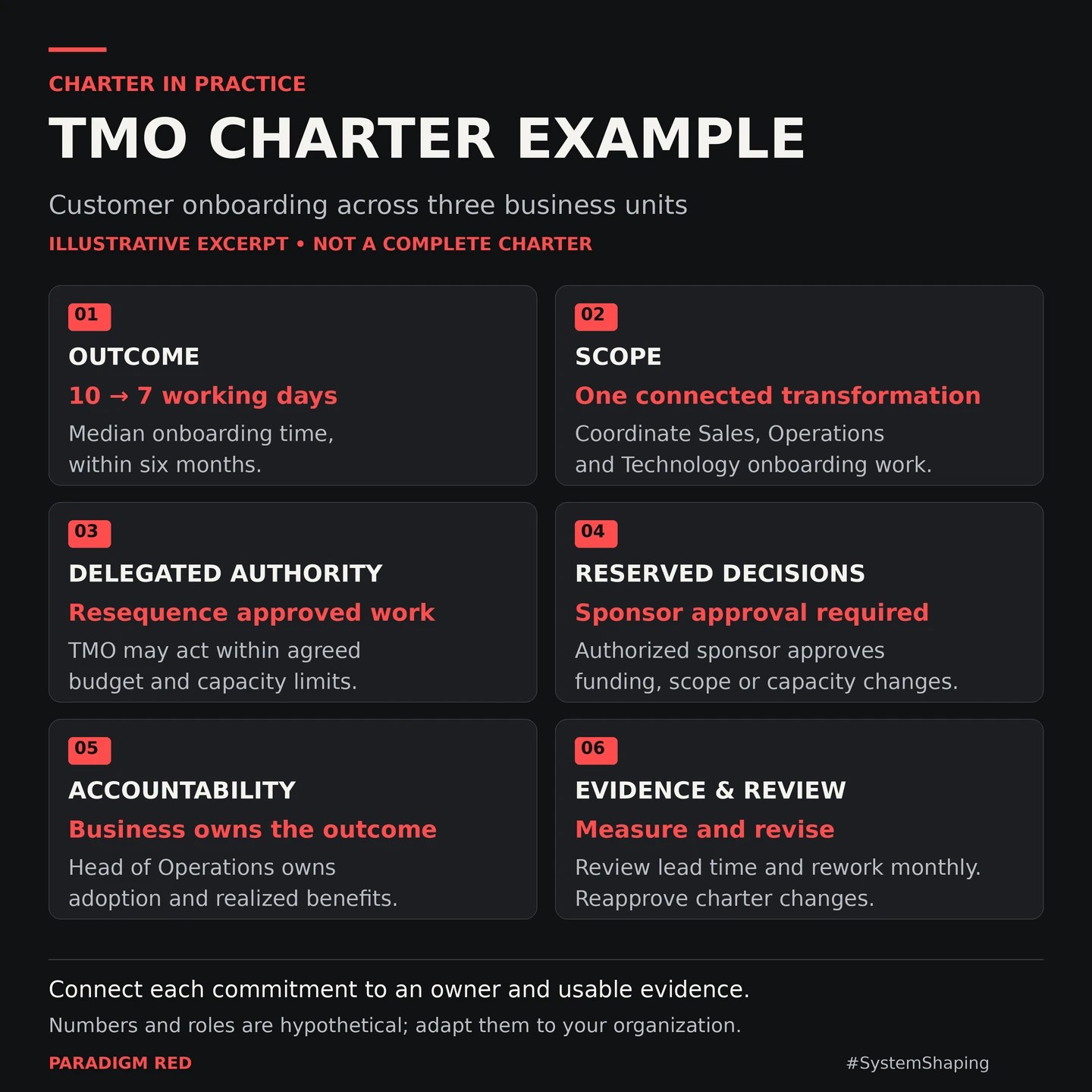
Hypothetical example: the organization, roles, figures, allocations, and thresholds below are illustrative. They show how clauses fit together; they are not benchmark targets, actual client results, or evidence that a charter causes a particular improvement.
1. Document control and approval
Customer Onboarding TMO Charter, version 1.0. The TMO lead maintains the document. The COO, acting as the authorized executive sponsor in this hypothetical organization, approves it. Day 0 is the recorded effective date; the mandate runs for six months, with monthly reviews.
2. Purpose and strategic outcomes
Reduce median onboarding time from 10 to 7 working days by the end of month six across three business units. Coordinate Sales, Operations, and Technology to remove recurring handoff delays. Keep onboarding rework at or below the illustrative 4% baseline.
3. Scope and exclusions
Included: approved onboarding workflow, data, and handoff improvements across the three units. Excluded: pricing policy, enterprise platform replacement, and unrelated service redesign. Those changes require separate authorization.
4. Sponsor and reporting relationship
The TMO reports to the COO. Unit operations heads, Sales, and Technology provide representatives. A sponsor-designated deputy with the required authority handles urgent decisions when the COO is unavailable.
5. Decision rights and limits
The TMO lead may resequence an approved activity by up to five working days only when agreed funding, committed capacity, scope, quality guardrails, and the month-six milestone remain unchanged. Changes to those boundaries are reserved for the authorized sponsor.
6. Responsibilities and reciprocal obligations
The TMO maintains integrated dependencies, prepares options, and records decisions. Initiative owners execute approved work. Functional leads confirm capacity and provide current delivery information. Delivery decisions remain with initiative owners within their existing mandates.
7. Adoption and benefits ownership
The Head of Operations owns adoption and realized benefits, supported by unit operations heads. The TMO tracks evidence and coordinates corrective decisions. Finance reviews any savings claim separately before it is treated as an established financial benefit.
8. Resources and information access
Functional leads commit a half-time TMO lead, two onboarding specialists for one day per week each, and a data analyst for one day per week. Existing approved funding supports the work; the TMO has no authority to approve additional spend. Access to relevant case timestamps and rework records is confirmed before launch.
9. Governance cadence and interfaces
Weekly dependency reviews resolve delivery interfaces. A monthly sponsor review considers portfolio trade-offs, outcomes, and capacity. Use one shared decision register. Existing finance and technology controls continue to apply.
10. Escalation and unresolved decisions
A conflict that exceeds delegated limits is submitted to the sponsor with options, impacts, and a recommendation. The illustrative response expectation is two working days. If unresolved, the designated deputy is engaged and affected delivery assumptions are explicitly revised.
11. Measures and evidence
The analyst measures working days from acceptance of a complete application to service activation, using one agreed calendar across units. Baselines come from the preceding eight weeks. Monthly reporting includes completed-case volume, open-case age, median lead time, and rework rate: the share of cases completed in that month that required at least one correction to accepted information or completed processing before activation. The same definition applies to the illustrative 4% baseline and guardrail.
12. Amendment, renewal, and exit
The TMO lead proposes changes; the authorized sponsor approves amendments. Revisit the mandate when scope, authority, capacity, or key assumptions change. At month six, the sponsor explicitly closes, extends, or transfers the mandate; the Head of Operations retains outcome monitoring and ownership of unresolved operational actions.
Tracking open-case age alongside completed cases matters: an improving median can hide difficult cases left unfinished. Measures should expose the system’s behavior rather than reward selective reporting.
TMO decision rights: what the office can and cannot decide
For each important decision, name the final authority before listing contributors. A RACI chart can clarify participation and responsibility, but it does not necessarily specify approval limits, reserved matters, or escalation deadlines. Connect the charter to your TMO roles and responsibilities and reporting structure without assuming a reporting line settles every decision.
APM’s governance guidance emphasizes defined authority and accountability, delegated limits, and escalation routes. Apply those principles to the decisions in your own mandate; they do not imply that every TMO should have identical powers.

| Decision | Final authority | TMO contribution | Boundary |
|---|---|---|---|
| Funding or major scope changes | Authorized executive or governance body | Prepare evidence; recommend or escalate. | No unilateral change unless that authority is explicitly delegated. |
| Portfolio changes within approved limits | TMO lead, only with explicit delegation | Choose within limits and record the rationale. | Recheck funding, capacity, scope, risk, and milestone constraints. |
| Delivery decisions within initiative scope | Initiative owner within their mandate | Coordinate dependencies and surface cross-team risks. | The TMO does not replace delivery ownership. |
| Operating changes needed for benefits | Named business owner within their mandate | Track outcome evidence and support corrective action. | Adoption and realized benefits remain with the business owner. |
In the onboarding example, the TMO may move an approved activity within the five-day allowance only if every stated condition still holds. A request for extra specialist capacity goes to the authorized sponsor. Permission to coordinate a portfolio is not automatic permission to expand its commitments. See transformation portfolio management for the wider trade-offs.
Escalation rules that lead to decisions
An escalation should identify a decision someone is empowered to make. “Resource risk: red” does not explain what is needed, by when, or what happens if no choice is made.

- Frame the conflict. Two onboarding initiatives need the same specialist during the same week. Compare resequencing, reducing concurrent work, and requesting extra capacity. State the impact of each option.
- Check authority and limits. If resequencing fits the charter’s five-day allowance and preserves all boundaries, the TMO lead can decide. Otherwise, take the decision to the authorized sponsor.
- Record and implement. Capture the decision, rationale, action owner, due date, and assumptions. Initiative owners carry out the agreed change; a decision log is not implementation.
- Review the result. Check the capacity conflict and its effects on onboarding, quality, and other work. New evidence may require another decision or a charter amendment.
Set a fallback when the primary authority does not respond. In this example, the two-working-day expectation triggers the designated deputy route; silence does not authorize the TMO to exceed its limits. Define these arrangements alongside the broader transformation governance model.
How to write and approve the charter
- Start with a recurring organizational problem. Specify the pattern the office must help change, such as unresolved dependencies or decisions detached from capacity. Avoid beginning with a preferred organization chart.
- Negotiate the boundaries. Identify included work, exclusions, reserved decisions, and reciprocal obligations. Ask whose existing authority or workload the proposed mandate affects.
- Secure actual commitments. Obtain resource allocations, information access, and agreement from the owners expected to deliver adoption and benefits.
- Test a real trade-off. Walk through a funding or capacity conflict. Can participants identify the final authority, required evidence, response expectation, and fallback route without improvising?
- Approve and communicate the operating mandate. Obtain approval from the appropriate authority, record the effective version and conditions, and brief the people whose decisions or obligations change. Make the current charter easy to find.
A signature is the beginning of use. Check whether forums, resource allocations, and actual decisions follow the approved clauses. If informal practice contradicts the document, resolve the mismatch rather than creating another reporting requirement.
TMO charter approval checklist
Use this as a review aid, not a scored or validated maturity assessment. An unchecked item should trigger a concrete correction or a clearly recorded approval condition that does not permit work outside existing authority.

- Mandate and scope: outcomes, included work, and exclusions are explicit.
- Authority: delegated limits, reserved decisions, escalation recipients, and fallback routes are confirmed.
- Resources: named people, time, funding, and information access are committed.
- Ownership: business owners accept adoption and benefits accountability.
- Evidence: measures have definitions, baselines, targets, guardrails, and data owners.
- Review and approval: the authorized approver, review dates, amendment rules, and exit arrangements are recorded.
Resolve missing authority, ownership, or capacity before authorizing work that depends on it. If approval is conditional, state which activities remain blocked until each condition is satisfied.
Common TMO charter mistakes
Vague clauses create room for different expectations to survive until pressure exposes them. Replace aspiration with an observable obligation and an identifiable owner.
| Weak clause | What to specify instead |
|---|---|
| “The TMO ensures transformation success.” | Identify the office’s controllable responsibilities and the business owners accountable for operating outcomes. |
| “The TMO manages priorities.” | Name the decisions it can make, their limits, and who decides outside those limits. |
| “Functions provide support as required.” | Record named resource commitments, approving managers, and a route for resolving competing demand. |
| “The TMO owns all benefits.” | Separate evidence coordination from the business authority needed to change operations and realize value. |
| “Success means complete status reporting.” | Measure decision effectiveness and constraints resolved alongside business outcomes and quality guardrails. |
| “The charter remains valid indefinitely.” | Set review triggers, amendment authority, and transfer or renewal conditions. |
The benefits realization guide develops the ownership distinction further. In its public-sector context, the UK Government’s Teal Book guidance requires clear benefits accountability and continued management through realization. The useful lesson here is to specify who can act on the operating conditions behind value, including after temporary transformation arrangements end.
When to review, revise, or retire the charter
Review the charter on its agreed schedule and when material conditions change: a new sponsor, different strategic outcomes, altered scope, reduced capacity, new risks, or repeated exceptions that reveal an unrealistic authority boundary.
Separate changes within the existing mandate from amendments to the mandate itself. Updating a dependency record may be routine operating work. Expanding decision authority requires approval through the defined amendment route, with a new version and effective date communicated to affected owners.
At closure or renewal, identify which capabilities should remain, who receives the decision history, and who owns open actions and benefits monitoring. A six-month office should not leave six months of unresolved accountability. Equally, reaching the target date should not cause continuing operational obligations to disappear.
From a TMO charter to System Shaping
A charter is useful when it helps change the conditions producing a recurring problem. If teams are rewarded only for local milestones, asking a TMO to “ensure collaboration” may leave the underlying incentive conflict intact. If capacity cannot be committed, a stronger reporting cadence will not create it.
The System Shaping perspective asks how authority, incentives, information, resources, and feedback interact. Apply that perspective clause by clause: does the mandate make the desired behavior possible, does it make cooperation worthwhile, and can evidence change the next decision?
In the onboarding example, the point is not the document itself. The point is that shared-capacity conflicts become visible, an authorized decision can be made, the business retains outcome ownership, and results influence future choices. Those are changes to how the organization works.
Develop the System Shaper perspective. Explore the System Shaping book to examine the structures, incentives, and feedback behind recurring organizational outcomes. Use the charter as one practical place to apply that thinking.
#SystemShaping
Frequently asked questions
What should a TMO charter include?
Include purpose, scope, sponsorship, decision rights, responsibilities, business outcome ownership, resources, governance, escalation, measures, and review or exit rules. Record document ownership and approval so readers know which version has authority.
Who approves a transformation management office charter?
The organizational authority empowered to approve its mandate and commitments. This may be an executive sponsor or governance body. Confirm that the approver can authorize the specific scope, resources, and delegation involved; a senior title alone is not enough.
How is a TMO charter different from a project charter?
A project charter concerns a particular project. A TMO charter defines the office’s purpose, services, authority, and interfaces across its specified transformation scope. Individual initiatives may still need their own authorizations and delivery arrangements.
Can a TMO approve or stop initiatives?
Only where the appropriate authority has explicitly delegated those decisions and the relevant limits are satisfied. Otherwise, the TMO prepares evidence and recommendations for the authorized decision-maker. Coordination responsibility does not imply unrestricted approval power.
How detailed should a TMO charter be?
Detailed enough to resolve the decisions and obligations that otherwise remain ambiguous. Keep the core mandate concise and place extensive matrices or procedures in referenced appendices. Readers should find authority limits and resource commitments without searching a methods manual.
When should the charter be updated?
At its agreed review points and when material changes affect strategy, sponsorship, scope, resources, risks, or authority. Repeated exceptions may also expose a need for revision. Follow the approved amendment route and communicate the new effective version.