Tag: systems thinking
Systems thinking is an approach to understanding how elements within a system interact to produce outcomes over time. Instead of focusing on isolated parts, it examines relationships, patterns, and feedback loops that shape behavior in organizations and complex environments.
Traditional problem-solving often treats issues as separate and linear. Systemic thinking reveals that most problems are interconnected and emerge from underlying structures. This perspective helps explain why solutions that address symptoms frequently fail to create lasting change.
On Paradigm Red, it is used as a foundation for understanding transformation, leadership, and complexity. It provides tools for recognizing patterns, identifying leverage points, and making better decisions in uncertain environments.
Core principles
- Focus on relationships rather than isolated elements
- Understanding feedback loops and system dynamics
- Recognizing patterns over time instead of single events
- Seeing how structure drives behavior
Why it matters
- Explains why problems persist or repeat
- Supports more effective decision-making
- Reveals high-impact leverage points
- Enables sustainable transformation
Related articles
-

What Is Organizational Coherence? Definition, Framework, and How to Build It
Organizational coherence is the capacity of strategy, structures, information, decisions, incentives, operations, and learning to reinforce one another so specialized teams can function as one adaptive…
-

Why Strategy Execution Fails: Fix the Execution System
Learn why strategy execution fails, how the execution gap forms, and how leaders can redesign the organizational system that turns strategy into results.
-
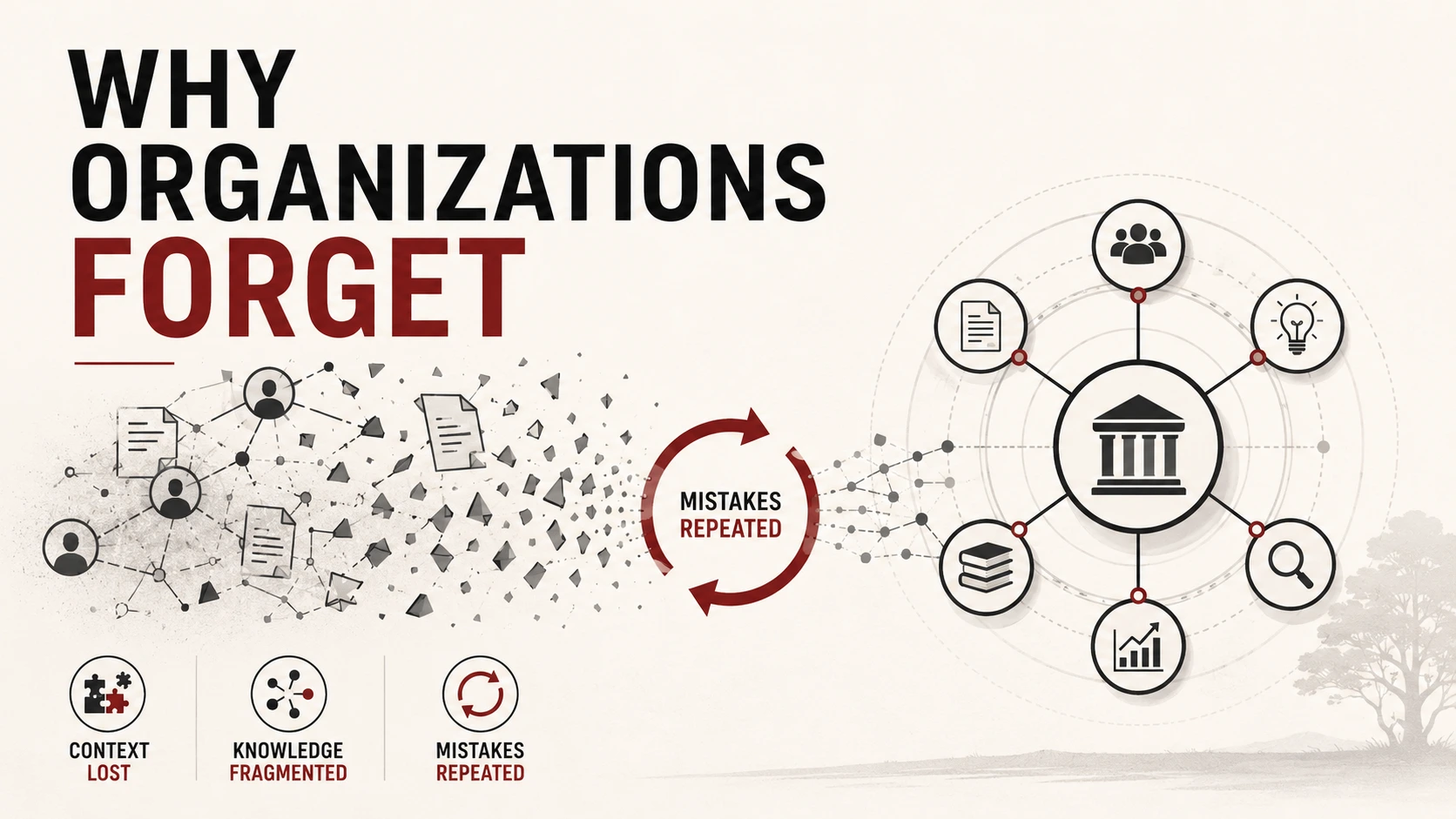
Organizational Memory: Why Organizations Forget What They Learn
Organizations can solve a problem, document the lesson, and still repeat the same failure. This article explains why organizational memory breaks—and how to build a system…
-

How to Build Organizational Sensemaking: From Weak Signals to Coordinated Action
A practical framework for turning fragmented signals into shared understanding, coordinated action, and continuous organizational learning.
-

Why Organizations Stop Seeing Reality
Organizations rarely fail because reality changes without warning. They fail when signals are filtered, narratives harden and leaders act on an internal story that no longer…
-

Why Organizations Lose Their Ability to Adapt
Why do successful organizations become less adaptable? Explore how adaptive capacity erodes—and how leaders can diagnose, reshape, and monitor the system.
-

What Is Organizational Intelligence? A Complete Framework
A complete executive guide to organizational intelligence: its definition, architecture, operating cycle, emergence, collapse, assessment, development, and relationship to System Shaping™.
-
How to Redesign an Organization Without Breaking It
A complete System Shaping™ guide to organizational redesign—covering architecture, coherence, adaptive transformation, maturity, and a practical executive playbook.
-
Why Organizations Resist Learning
Why do smart organizations repeat the same mistakes? Discover Learning Debt™, Knowledge Friction™, institutional memory, and the System Shaping™ Organizational Learning Architecture.
-

Why Organizations Become Siloed (And Why Reorganizations Usually Fail to Fix It)
Organizational silos rarely appear overnight. They emerge gradually when growing systems become better at optimizing individual parts than integrating the whole. Estimated reading time: 30–35 minutes…