Systems Thinking & Coaching · #SystemShaping
Editorial style: Paradigm Red lowercases russia, russian place names and russian personal names, including inside quotations. Source wording is otherwise preserved. This article evaluates published arguments and their consequences; it does not claim access to anyone’s private motives.

Ichak Adizes is a serious management thinker. His work on organizational lifecycles, complementary leadership roles and integration has helped leaders see that recurring problems are often produced by systems rather than by isolated incompetence. That is precisely why Ichak Adizes on russia matters: when a respected systems thinker gets a consequential prediction wrong, the failure reveals the boundary of the method.
On 19 January 2022, Adizes wrote that “russia is not threatening the West”, rejected the idea that putin sought geographic expansion and placed the main causal burden on NATO and Washington. Thirty-six days later, russia launched its full-scale invasion of Ukraine. The United Nations General Assembly subsequently adopted a resolution titled Aggression against Ukraine and demanded that russia end its use of force and withdraw its troops.[3][5]
Did Ichak Adizes support russia? The public record does not show him endorsing the invasion; he explicitly said he was “not supporting or justifying war.” But intent and analytical effect are different questions. His pre-invasion argument denied expansionist intent, treated russia as primarily reactive and assigned the West a central causal role. That frame functioned as an exculpatory explanation for the state that invaded Ukraine weeks later.[4]
Key takeaways
- Adizes’s organizational method is strongest where participants share a system, rules and a reason to preserve the whole.
- His January 2022 analysis made a falsifiable claim about russia’s intent, and the full-scale invasion contradicted it.
- The deeper error was not “too much context.” It was context without a sufficiently explicit account of concentrated power, sovereign agency and asymmetric responsibility.
- Later essays moved from NATO pressure toward leader psychology and russian culture, but never fully rebuilt the original causal and moral frame.
- The answer is not to discard systems thinking. It is to make it power-aware, falsifiable and accountable.
Why this failure matters
The official description of the Adizes methodology presents organizations as living systems. It emphasizes continuous change, root-cause diagnosis, complementary PAEI roles, mutual trust and respect, and the integration of conflict without destroying the organization. Its implementation is explicitly organizational: an 11-phase process intended to align structures, roles, culture and decision-making.[1]
That is a genuine contribution. Leaders routinely mistake a structural problem for a personality problem. They punish visible symptoms, reorganize boxes, introduce another process or replace a manager while leaving incentives, authority, interfaces and feedback loops unchanged. A systems lens asks what conditions repeatedly produce the behaviour. Paradigm Red applies the same logic in systems change management: an intervention changes relationships and generates feedback across an adaptive whole.
But organizational therapy contains an often-unspoken boundary condition. The participants normally remain members of the same organization. They may disagree over interests, priorities, identity or status, yet they operate inside a shared legal and institutional container. They have some reason to preserve the whole, and a governance system can ultimately define authority.
War between states is different. One actor may reject the shared rules, deny another actor’s sovereignty, use coercion deliberately and accept extraordinary collective losses to preserve regime power. Under those conditions, conflict is not necessarily a dysfunction waiting for integration. It can be the chosen instrument of domination.
The failure of Ichak Adizes on russia therefore exposes a category error: a method built to repair conflict inside a shared system was extended to an actor willing to violate the system itself.
What did Ichak Adizes say about russia before the invasion?
The record is more revealing when read chronologically, because it shows that Adizes could perceive authoritarian power and expansion risk—then displaced those insights when he analyzed Ukraine.
- 11 January 2022In an essay about Kazakhstan, Adizes argued that democratic uprisings threatened putin’s regime, warned that putin might seek ethnic russian populations beyond russia’s borders and recalled telling Kazakhstan’s leadership that the country was vulnerable to partition. This was a power-aware warning: regime survival, demographic ambition and coercive capacity were visible in the model.[2]
- 19 January 2022Eight days later, his Ukraine analysis moved in the opposite direction. He wrote that putin did not want geographic expansion, said “russia is not threatening the West”, described NATO as the threatening actor and suggested that Washington’s domestic problems or its military-industrial interests might help explain the crisis.[3]
- 20 January 2022After criticism, Adizes stressed that explanation was not endorsement. He said he was analyzing the system, not taking a political position, and explicitly denied supporting or justifying war.[4]
- 24 February 2022russia launched the full-scale invasion of Ukraine. The central claim—no expansionist intent and no threat from russia—failed its reality test.
Adizes’s missile argument also depended on a hypothetical future. He imagined NATO nuclear missiles in eastern Ukraine, five minutes from moscow, even though Ukraine was not a NATO member and NATO’s collective-defence guarantee did not apply to it in January 2022.[12] Contextual fear can be analyzed, but a feared scenario is not the same as an existing deployment—and perception does not remove the agency of the person who chooses a war.

Did Adizes support russia—or only try to explain it?
A responsible answer must separate three questions: intent, content and effect.
Intent: Adizes said he did not support or justify war. Nothing in the cited essays proves that he privately wanted the invasion or approved of its human consequences. It would be unfair to convert an analytical failure into an unsupported claim about personal motive.
Content: his January argument nevertheless reproduced the central structure of a kremlin-aligned justification: NATO was advancing; russia was reacting; putin did not seek expansion; Ukraine’s sovereign choice was secondary; and Western elites had ulterior motives. The analysis distributed suspicion generously toward Washington while extending interpretive charity toward the actor concentrating troops around Ukraine.
Effect: an argument can function as exoneration even when its author declares neutrality. If the aggressor becomes a predictable output of external pressure, agency migrates away from the decision-maker. Responsibility is not denied explicitly; it dissolves inside the causal story.
Explanation becomes exoneration when context is described in detail but the power to choose is treated as background noise.
Adizes himself recognized the tension when he wrote that people act as if understanding is “half forgiving.” His answer was to insist that analysis is not a position. But neutrality is not established by declaration. It depends on whether the model applies the same evidentiary standards, preserves the difference between pressure and force, and identifies who could have chosen otherwise.
Why the Adizes prediction failed
The problem was not systems thinking itself. The problem was systems thinking without power. Five analytical moves made the failure more likely.
1. The context became the protagonist
NATO expansion, missile proximity, domestic politics in Washington and the military-industrial complex occupied the centre of the story. putin appeared mainly as a responder to those forces. Yet systems contain actors with unequal authority. Explaining the environment around a choice cannot substitute for analyzing the actor empowered to make it.
2. The system boundary excluded Ukrainian agency
The essay largely modeled a confrontation between the West and russia. Ukraine appeared as territory, a prospective NATO platform and a population containing russian speakers—not as a sovereign political community with its own history, security problem and right to choose. When the object of coercion disappears from the system map, aggression can be misread as bargaining between larger powers.
3. Constraint became destiny
A system can make a choice more attractive, costly or probable. It does not make every choice inevitable. The analytical bridge from “russia perceives NATO as threatening” to “russia therefore invades” contains agency, ideology, command authority and alternatives. Those are not minor variables. They are where political and moral responsibility live.
4. Explanation and justification were separated rhetorically, not structurally
Adizes verbally rejected justification. Structurally, however, his account placed responsibility for the crisis on actors other than the state that initiated the full-scale invasion. A model that repeatedly explains one side’s coercion through its fears while treating the other side’s self-determination as provocation creates moral asymmetry in the wrong direction.
5. The failed forecast did not trigger a full model rebuild
The invasion contradicted the claim about intent. A learning system should not merely add a new explanation after failure; it should revisit the assumptions that produced the forecast. Paradigm Red’s guide to organizational learning makes this distinction explicit: experience becomes learning only when it changes future interpretation and action.
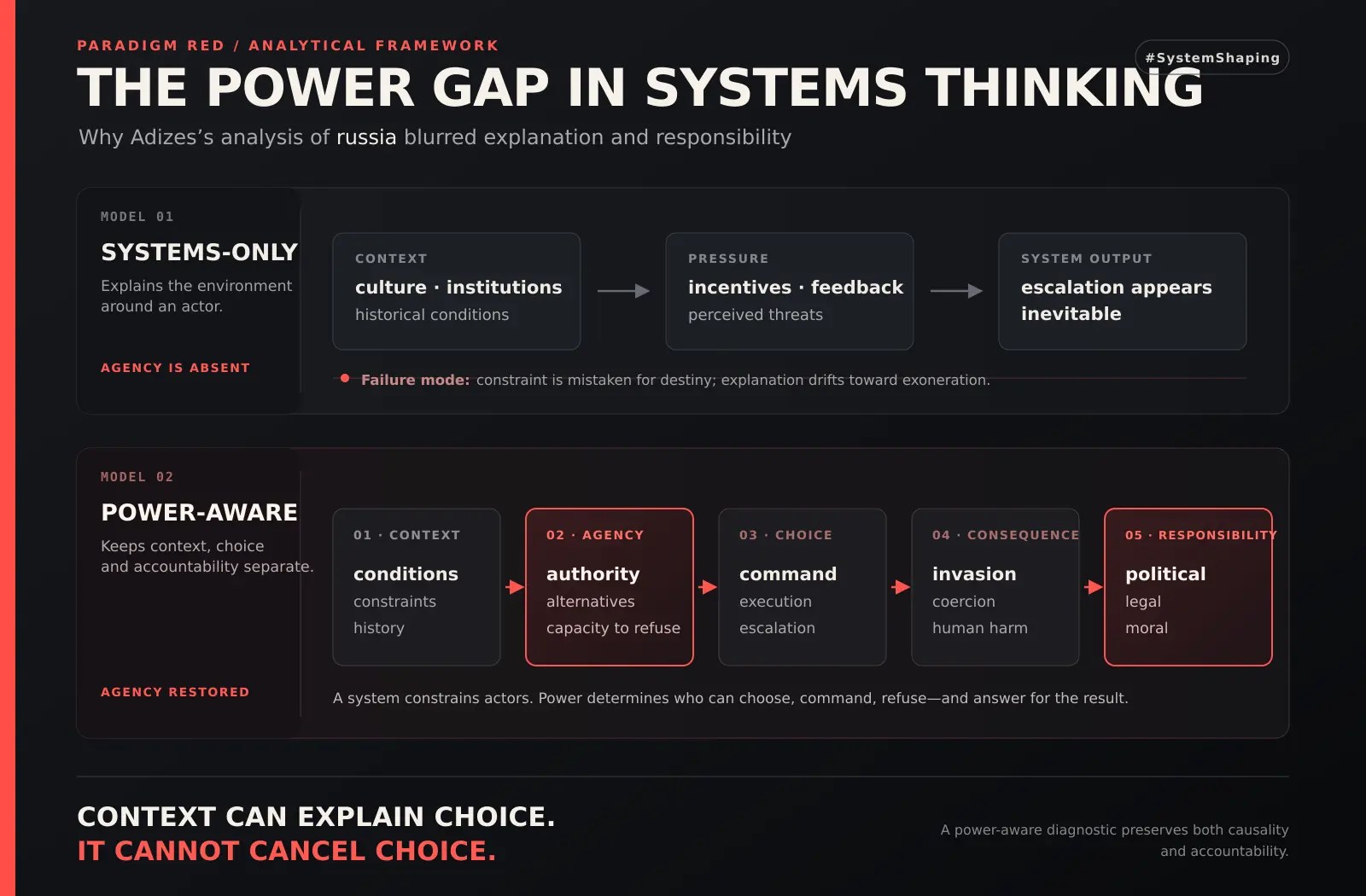
| Diagnostic question | Systems-only reading | Power-aware correction |
|---|---|---|
| What creates pressure? | Security fears, history, incentives and feedback | Retain the context, but distinguish perceived pressure from verified conditions |
| Who can decide? | The actor appears as a vehicle of the system | Name command authority, alternatives and capacity to refuse |
| Who is inside the system? | Great powers define the frame | Include the sovereignty and agency of the people being acted upon |
| What would prove the model wrong? | New events are absorbed into a revised story | Specify predictions and change the model when evidence contradicts them |
| Who is responsible? | Responsibility diffuses across the environment | Connect chosen action to political, legal and moral accountability |
The three tests the analysis did not pass
A geopolitical systems analysis should pass at least three tests before it is treated as a credible explanation.
The agency test
Who held decision authority, what alternatives existed, and who had the capacity to refuse? If the actor is described only as a product of culture or pressure, agency has disappeared.
The asymmetry test
Who initiated coercion, who was targeted, who controlled escalation and who could stop? Suffering on several sides does not make causal or moral roles equal.
The falsification test
What observable event would change the diagnosis? If a full-scale invasion cannot overturn a claim of non-expansionist intent, the model is insulated from reality.

International law makes the asymmetry explicit
Context does not erase the legal baseline. Article 2(4) of the United Nations Charter prohibits the threat or use of force against another state’s territorial integrity or political independence.[6] On 2 March 2022, the General Assembly voted 141–5, with 35 abstentions, for a resolution identifying the aggression against Ukraine and demanding withdrawal.[5]
The consequences are not abstractions. UNHCR’s December 2025 snapshot recorded 5.3 million refugees and asylum-seekers from Ukraine worldwide, 3.8 million people displaced inside Ukraine and 12.7 million people requiring urgent humanitarian assistance.[10] These consequences matter because a system explanation that foregrounds the aggressor’s insecurity while backgrounding the target’s destruction reproduces the very asymmetry it claims to transcend.
The International Criminal Court issued arrest warrants for vladimir putin and maria lvova-belova in March 2023 over alleged war crimes involving the unlawful deportation and transfer of Ukrainian children.[11] The UN Commission of Inquiry has also reported war crimes and serious violations committed by russian authorities.[13]
Legal precision: an arrest warrant is not a conviction. It reflects a judicial finding that the legal threshold for issuing the warrant was met. This article cites it to show why individual authority and responsibility cannot be dissolved into cultural or systemic context.
How Adizes’s argument changed after the invasion
Adizes did not simply repeat the January 2022 essay. His later writing contains partial revisions. The problem is that those revisions changed the surface explanation without fully correcting the original distribution of agency and responsibility.
November 2022: suffering and public relations
In an essay comparing Israel, Serbia and russia, Adizes argued that all parties suffer in war, acknowledged that suffering may be unequal and focused on why russia did not explain its own suffering more effectively to world opinion. The humanitarian intuition—that no suffering should be ignored—is defensible. The analytical problem is placement. In a war of aggression, moving quickly from invasion to the aggressor’s image and unrecognized pain can turn asymmetry into a public-relations problem.[7]
January 2023: putin as an escalating leader
Adizes later used his Type (E) framework to describe national leaders who cannot accept defeat and therefore escalate confrontation until they produce the outcome they fear, explicitly pointing to putin and the war in Ukraine. This was a meaningful shift: leader psychology and destructive choice became more visible than in the pre-invasion NATO-centred account.[8]
May 2025: dictatorship explained through russian culture
The shift did not hold. In 2025, Adizes wrote that “putin did not create a dictatorship—he merely follows the culture” and generalized from his consulting experience that russian people were not culturally ready or capable of democratic behaviour. He also said sanctions had prevented the Adizes Institute from continuing its work in russia.[9]
This explanation again relocates responsibility. A ruler with coercive institutions becomes the expression of a national character, while the population—including dissidents, prisoners, exiles, protesters and people silenced by repression—becomes culturally responsible for its ruler. Culture influences behaviour, but it is neither homogeneous nor destiny. A meeting inside a hierarchical company cannot establish that an entire people is incapable of democracy.
The model therefore shifted, but the symmetry problem remained. External pressure, leader personality and culture alternated as explanations; concentrated coercive power was never integrated as the organizing variable that changes the meaning of the whole system.
The old model versus the new reality
Adizes did not “lose” because integration, mutual trust or systems diagnosis suddenly became worthless. He lost because the reality to which he applied them violated their boundary conditions.

Inside the old model, conflict signals dysfunction. Actors may be selfish, but they normally need the shared organization to survive. Interdependence gives them a reason to cooperate. Dialogue can reveal common interests, and pressure produces adaptation.
Under concentrated authoritarian power, each assumption can invert:
- Conflict can be strategy, not a symptom.
- A regime can sacrifice shared welfare to preserve control.
- Interdependence can be weaponized through energy, finance, information or infrastructure.
- Dialogue can buy time or manufacture ambiguity rather than reveal common interest.
- Ideology and personal agency can override incentives that appear rational to an outside observer.
A method built to integrate conflict cannot explain every actor who uses conflict to dominate. The missing variable is not another feedback loop. It is power.
Where the Adizes method still works—and where it reaches its limit
A fair critique should preserve what remains useful. The boundary map below combines two variables: how power is distributed and whether actors accept shared rules.

Distributed power plus shared rules: this is the strongest fit. Integration, complementary roles, lifecycle diagnosis and mutual trust can improve the whole because the participants accept the container.
Concentrated power plus shared rules: the method can still help, but only when governance, checks, decision rights and accountability are explicit. Paradigm Red’s guide to collective decision-making makes a relevant distinction: contribution, final authority and action ownership must not be blurred.
Distributed power plus rejected rules: facilitation becomes unstable because no process can manufacture commitments that actors refuse to make.
Concentrated power plus rejected rules: integration logic becomes dangerous. Domination is misdiagnosed as misalignment, coercion as communication failure and resistance as another perspective to integrate. Here, power analysis must precede facilitation.
This boundary does not condemn the Adizes method. It locates it. A tool becomes more credible when it states where it should not be used.
A power-aware replacement for geopolitical systems analysis
#SystemShaping extends the systems lens rather than abandoning it. The practical replacement is a six-step protocol that keeps context while preventing context from erasing responsibility.

- Map context. Identify history, incentives, dependencies, fears, institutions and feedback loops. Treat perceptions as variables to verify, not as facts to inherit.
- Locate power. Ask who controls force, information, law, resources and institutional vetoes. Formal titles matter less than the capacity to command and punish.
- Trace choice. Identify realistic alternatives, decisions, refusals and escalation points. A constrained actor can still possess decisive agency.
- Preserve asymmetry. Distinguish initiator from target, coercion from defence, threat perception from use of force, and the capacity to stop from the need to survive.
- Test the model. State what evidence would disprove the diagnosis. Compare forecast with outcome and revise underlying assumptions—not only the story told afterward.
- Assign responsibility. Connect authority and chosen action to political, legal and moral consequences. Responsibility can be distributed, but it should not be dissolved.
This protocol also depends on collective thinking: people in different positions see different parts of a system, but hierarchy and incentives can suppress inconvenient signals. The goal is not consensus. It is a model that can absorb dissent, evidence and consequences. The distinction is developed further in what collective thinking means.
The final verdict: keep, reject, rebuild
Adizes’s russia analysis should not turn him into either a villain or an untouchable “living genius.” Both reactions avoid the work of judgment. The better response is selective.

Keep lifecycle thinking, complementary roles, integration under shared rules and the discipline of diagnosing beneath symptoms.
Reject false moral symmetry, context that erases agency, culture treated as destiny and explanations that remain intact after their predictions fail.
Rebuild the method around power before integration, choice before inevitability, aggressor–victim asymmetry and accountability after consequence.
Why did Adizes lose in the new reality? Because he treated a coercive project as if it were a conflict inside a system still seeking integration. The failure was not that he explained too much. It was that he located causality everywhere except clearly enough in the actor who could choose, command, invade and stop.
The systems lens still matters. The new task is to make power, agency and responsibility visible.
That is the #SystemShaping upgrade: do not stop at asking what conditions produce behaviour. Ask who shapes those conditions, who benefits from them, who can refuse, who bears the consequences and what evidence would force the model to change.
Frequently asked questions about Ichak Adizes on russia
Did Ichak Adizes support russia’s invasion of Ukraine?
There is no cited public statement in which Adizes endorses the invasion. He explicitly said he was not supporting or justifying war. However, his January 2022 analysis denied russian expansionist intent, framed NATO as the threatening actor and reduced Ukraine’s agency. It is therefore fair to criticize the argument as exculpatory without claiming that Adizes privately desired the war.
What exactly did Adizes predict before the invasion?
On 19 January 2022, Adizes wrote that putin did not want geographic expansion and that “russia is not threatening the West.” russia launched its full-scale invasion of Ukraine on 24 February 2022, contradicting the core forecast.
Why did the Adizes analysis of russia fail?
It gave extensive weight to external pressure while underweighting concentrated power, ideology, Ukrainian sovereignty, decision authority and available alternatives. Context became a substitute for agency, and the model lacked a clear mechanism for being falsified and rebuilt.
Does this mean NATO policy is irrelevant?
No. NATO history, security dilemmas and threat perceptions are legitimate parts of the context. The point is narrower: none of them makes invasion inevitable or transfers responsibility for the choice to use force away from the actor who made it.
Is systems thinking useless in geopolitics?
No. Systems thinking remains valuable for understanding feedback, interdependence, institutional incentives and unintended consequences. It becomes unreliable when it treats actors as automatic system outputs, flattens moral asymmetry or refuses to update after failed predictions.
Where is the Adizes method still useful?
It remains useful for organizational lifecycles, complementary leadership roles, root-cause diagnosis, integration and change inside systems where actors broadly accept shared rules. Its fit declines as power concentrates and rule commitment disappears.
What is power-aware systems analysis?
It is systems analysis that explicitly maps decision authority, coercive capacity, alternatives, asymmetry, consequences and accountability. It explains context without treating context as destiny and states what evidence would make the diagnosis change.
Primary sources and evidence
- Ichak Adizes, “What Is the Adizes Symbergetic Management Methodology?”, 23 May 2025.
- Ichak Adizes, “What Is Happening in Kazakhstan? An Insider’s Analysis”, 11 January 2022.
- Ichak Adizes, “russia vs. Ukraine: An Analysis of the Tense Situation”, 19 January 2022.
- Ichak Adizes, “The russia–Ukraine Situation: A Clarification”, 20 January 2022.
- United Nations General Assembly, “Aggression against Ukraine,” A/RES/ES-11/1, 2 March 2022.
- United Nations Charter, Article 2(4).
- Ichak Adizes, “What Is Common to Israel, Serbia, and russia? My Personal Observation”, 11 November 2022.
- Ichak Adizes, “Challenge Addiction”, 6 January 2023.
- Ichak Adizes, “putin: a Dictator. Why?”, 9 May 2025.
- UNHCR, “Ukraine Emergency”, humanitarian snapshot updated December 2025.
- International Criminal Court, arrest warrants for vladimir putin and maria lvova-belova, 17 March 2023.
- NATO press conference confirming Ukraine was not a NATO member, 12 January 2022.
- UN Independent International Commission of Inquiry on Ukraine, findings on war crimes and violations, 16 March 2023.
Continue the #SystemShaping path
Power-aware diagnosis is part of a broader practice: understand the conditions that produce behaviour, clarify who can decide, preserve useful disagreement and make reality capable of changing the model.