Delivery assurance is the structured assessment of whether a project, program, or technology delivery commitment is credible, using evidence about plans, capacity, dependencies, quality, risks, and intended outcomes. Its purpose is to give decision-makers a reasoned view of delivery confidence and identify where action is needed.
A green status report is a claim. Delivery assurance examines the evidence behind it: whether the remaining work is feasible, critical dependencies are available, acceptance criteria can be met, and the people making commitments understand the risks. The useful output is a finding that leads to a decision, an owner, and a way to verify the result.

This guide covers project, program, and software delivery assurance. Organizations use the term differently; the working model here emphasizes evidence, objective challenge, and follow-through. The six-area framework and review templates are practical editorial tools, not a certified standard or a guarantee of delivery.
What is delivery assurance?
Delivery assurance asks whether there is a defensible basis for trusting a commitment. It connects what the team reports with what sponsors, customers, delivery teams, and operational owners need to know before accepting risk or allocating resources.
The Association for Project Management’s governance guidance links assurance to confidence in intended benefits and emphasizes objectivity, independence, and proportionate attention to risk. That foundation matters: a review should be able to challenge a favorable report without depending on the report’s author to approve its conclusions.
Independence does not necessarily mean hiring an external consultant. It requires clear reporting arrangements, access to evidence, and sufficient separation from the work being assessed. Team self-assessment is useful, but its limitations should be explicit. The APM Assurance SIG toolkit can support both independent reviews and project-team self-assessment, adapted to context.
Confidence is conditional. A reviewer might conclude that a milestone is credible only if a supplier delivers an interface by an agreed date. Record that condition, the evidence behind it, and what happens if it fails. Unknowns should remain visible rather than being converted into reassuring numbers.
Delivery assurance vs delivery management, QA, PMO, and audit
These functions can cooperate and sometimes share a team, but their mandates should remain clear. The comparison below describes typical responsibilities, not a universal organizational chart.
| Function | Main question | Typical contribution |
|---|---|---|
| Delivery assurance | Is the commitment credible? | Evidence review, confidence assessment, challenge, escalation, and verification of corrective effects. |
| Delivery management | How will we deliver the agreed outcome? | Planning, coordination, forecasting, execution, and corrective action. |
| Quality assurance | Are quality processes and controls effective? | Assessment of quality practices, process adherence, and improvements; testing provides additional product evidence. |
| PMO | How is delivery organized and governed? | Methods, reporting, coordination, and governance support within its mandate. |
| Independent audit | Are governance, risk management, and controls effective within the audit scope? | Independent assessment and reporting under an audit mandate; this can overlap with delivery concerns. |

A Transformation Management Office may coordinate assurance across a transformation portfolio. It should still be clear who assesses confidence, who manages delivery, and who can approve a revised commitment. Assurance should not quietly inherit responsibility for delivering the project it reviews.
What does a delivery assurance manager do?
The delivery assurance manager turns fragmented signals into a reasoned assessment. This requires access to delivery teams and stakeholders, enough domain knowledge to question evidence, and an escalation route that works when the finding is inconvenient.
- Agree the review scope, evidence requirements, and reporting relationship.
- Compare reported progress with forecasts, dependencies, acceptance evidence, and stakeholder concerns.
- Distinguish an observed problem from a hypothesis about its cause.
- Explain which commitments are threatened and what remains uncertain.
- Present decision options to the person with the authority to act.
- Track agreed responses and verify their effect on delivery risk.
The delivery manager normally coordinates recovery. Sponsors or delegated governance bodies authorize changes beyond delivery authority. Assurance evaluates the response without becoming the sole designer and judge of the same recovery plan. This boundary belongs in transformation governance, not merely in a meeting invitation.
A delivery assurance framework: six assessment areas
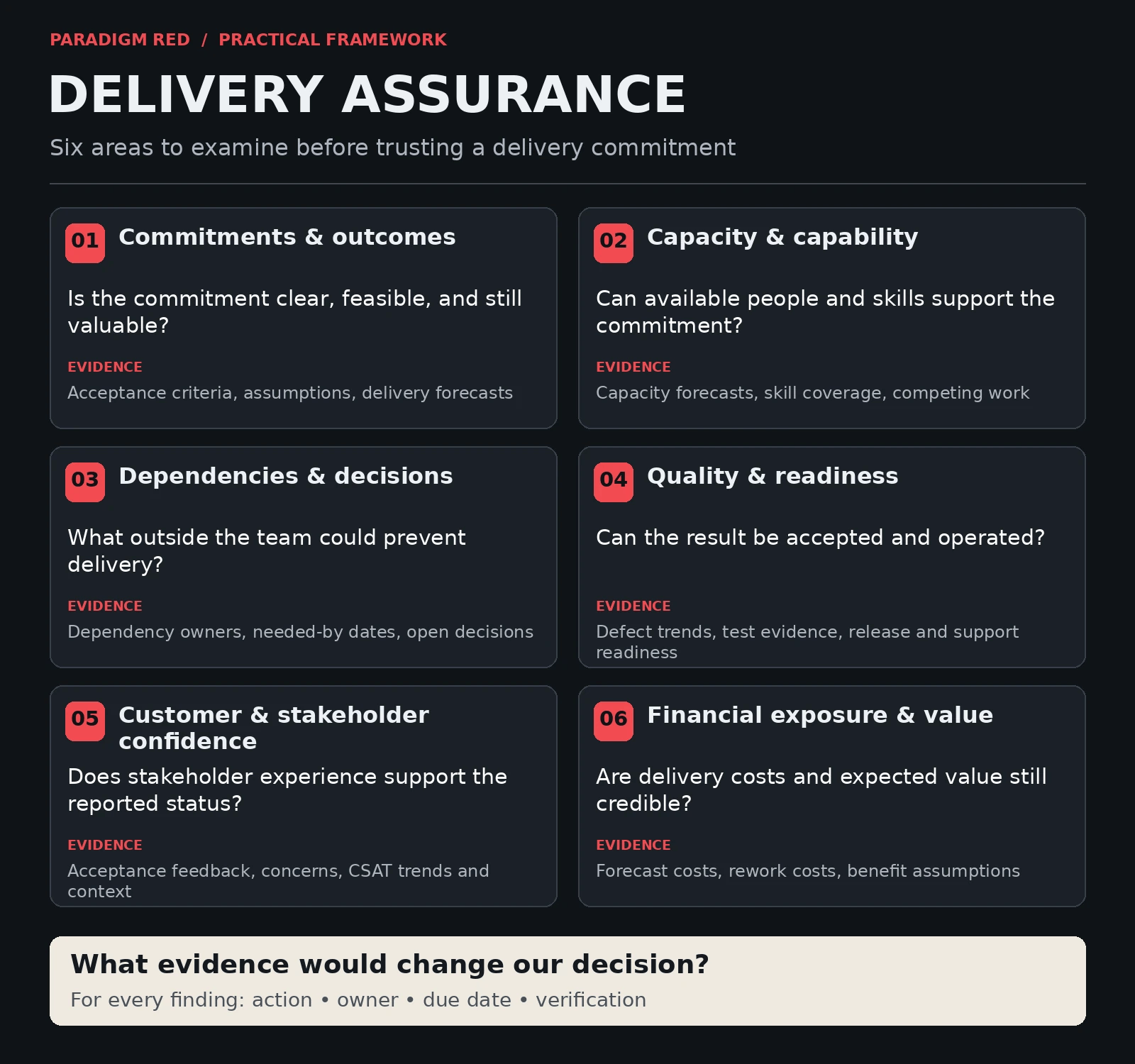
1. Commitments and outcomes
Start with the outcome, scope, date, acceptance criteria, and assumptions. Identify what changed since the commitment was made. A milestone is difficult to assure if different stakeholders disagree about what completion means. Ask whether the outcome still justifies the effort.
2. Capacity and capability
Compare remaining demand with realistic availability by role and skill. Include support work, leave, rework, and competing commitments. A team can have sufficient headcount but lack a critical specialist. Avoid treating full utilization as proof of capacity to absorb surprises.
3. Dependencies and decisions
Trace external inputs, approvals, environments, suppliers, and cross-team decisions to the commitments they enable. Assign owners and needed-by dates. A dependency can be marked active while already consuming the time reserved for integration or acceptance.
4. Quality and operational readiness
Examine whether acceptance evidence covers what matters, not only how many tests ran. Include defect severity, representative environments, support arrangements, and recovery readiness. A feature can be implemented without being ready for customer use or operational ownership.
5. Customer and stakeholder confidence
Compare the status narrative with acceptance feedback and unresolved concerns. CSAT or NPS may contribute context, but small response counts, timing, and respondent selection affect interpretation. A favorable survey does not cancel a failed acceptance criterion.
6. Financial exposure and value
Review the forecast cost of completing the agreed scope, rework costs, and the assumptions supporting expected benefits. Distinguish delivery completion from realized value. A cheaper release that misses its essential outcome may not be a successful trade-off.
Use organizational change capacity to examine competing demands, dependency management for cross-team exposure, and benefits realization for the link between outputs and value.
How the delivery assurance process works
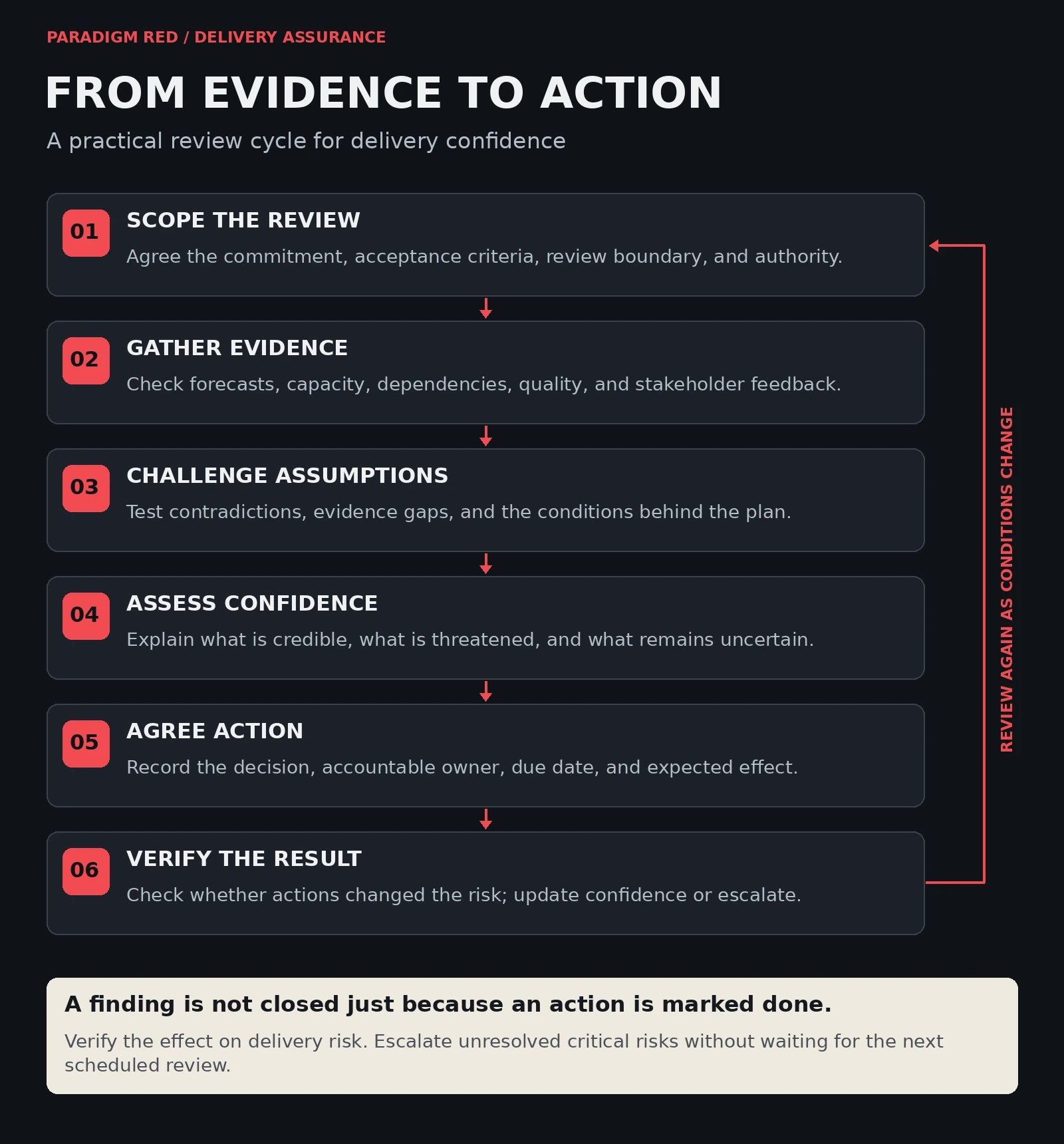
1. Scope the review
Choose the commitment being assessed and the decisions the review should inform. Agree the time horizon, evidence access, reviewers, and escalation route. Increase review depth where consequences or uncertainty justify it.
2. Gather evidence
Use dated forecasts, work records, demonstrations, acceptance results, dependency confirmations, and stakeholder conversations. Identify the source and owner. Several reports copied from one forecast are not independent confirmation.
3. Challenge assumptions
Look for contradictions between the plan and operating reality. Ask what would have to be true for the commitment to hold, and which assumptions lack support. Seek alternative explanations before attributing a problem to one team.
4. Assess confidence
Write a concise rationale covering evidence, material threats, uncertainty, and conditions. If using red, amber, or green, define the categories locally and show the reasoning. “Insufficient evidence” should remain a distinct finding.
5. Agree action
Specify the decision, authorized decision-maker, action owner, due date, and expected effect. Options may include resolving a dependency, changing sequence, reducing scope, revising a date, or accepting a documented risk.
6. Verify the result
Revisit the relevant evidence after action. A completed task is not proof that the risk has reduced. Keep the finding open, revise it, or escalate it according to the observed effect.
Use a cadence proportionate to risk: short reviews for changing conditions, deeper assessments before consequential commitments, and triggered reviews after material changes. Avoid collecting the same evidence independently for several overlapping forums.
Delivery assurance KPIs and early warning signals
Choose measures because they inform a decision. Define the population, time window, source, owner, and interpretation before comparing results. Thresholds should reflect the commitment and context; the examples below are prompts, not industry benchmarks.
| Measure | Definition or evidence | Decision it can inform |
|---|---|---|
| Forecast movement | Movement in the forecast completion date against an agreed baseline; record scope changes separately. | Whether to replan, investigate a constraint, or revise the commitment. |
| Critical dependency exposure | Critical inputs whose forecast arrival exceeds their needed-by date; include downstream impact. | Escalate, resequence, or agree an alternative. |
| Decision age | Elapsed working days since a decision became ready for an authorized decision-maker. | Remove an approval bottleneck or clarify authority. |
| Capacity gap | Remaining demand minus realistic available capacity, using consistent units and skill groups. | Reduce demand, change sequence, or secure suitable capability. |
| Rework effort share | Correction effort divided by total delivery effort in the same period; define what counts as correction. | Investigate recurring defects, unclear requirements, or unstable inputs. |
| Acceptance readiness | Evidence for critical acceptance criteria and unresolved material exceptions. | Continue, limit, or defer release based on unmet requirements. |
| Failure cost | Agreed costs attributable to rework, incidents, or service recovery; prevent double counting. | Prioritize corrective investment and revisit cost forecasts. |
| Stakeholder feedback | Concerns and survey trends with response counts, timing, and context. | Investigate dissatisfaction or conflicting expectations. |
| Corrective-action effectiveness | Actions whose intended risk reduction has been verified, with unresolved critical findings shown separately. | Close findings or require a stronger response. |
Use trends and underlying examples together. Averages can conceal an overdue critical dependency. Story-point velocity is a local planning input, not a comparable productivity score across teams. A rising number of closed actions is not reassuring when the most important risk remains unresolved.
Where DORA metrics fit in software delivery assurance
The current DORA software delivery guidance uses five measures: change lead time, deployment frequency, failed deployment recovery time, change fail rate, and deployment rework rate. They describe software delivery performance, not every condition needed to meet a project commitment.
Review them at an appropriate application or service level and avoid comparisons that ignore context. Use them alongside acceptance, dependency, capacity, and customer evidence. DORA deployment rework rate concerns unplanned deployments following production incidents; it is different from the effort-based rework measure in the table above.
Worked example: green status, weakening delivery confidence
Fictional scenario: a software release is reported green because its date is unchanged and 18 of 20 planned tasks are marked complete. However, the two remaining tasks cover integration and critical customer journeys. Task counts do not represent their effort or risk.
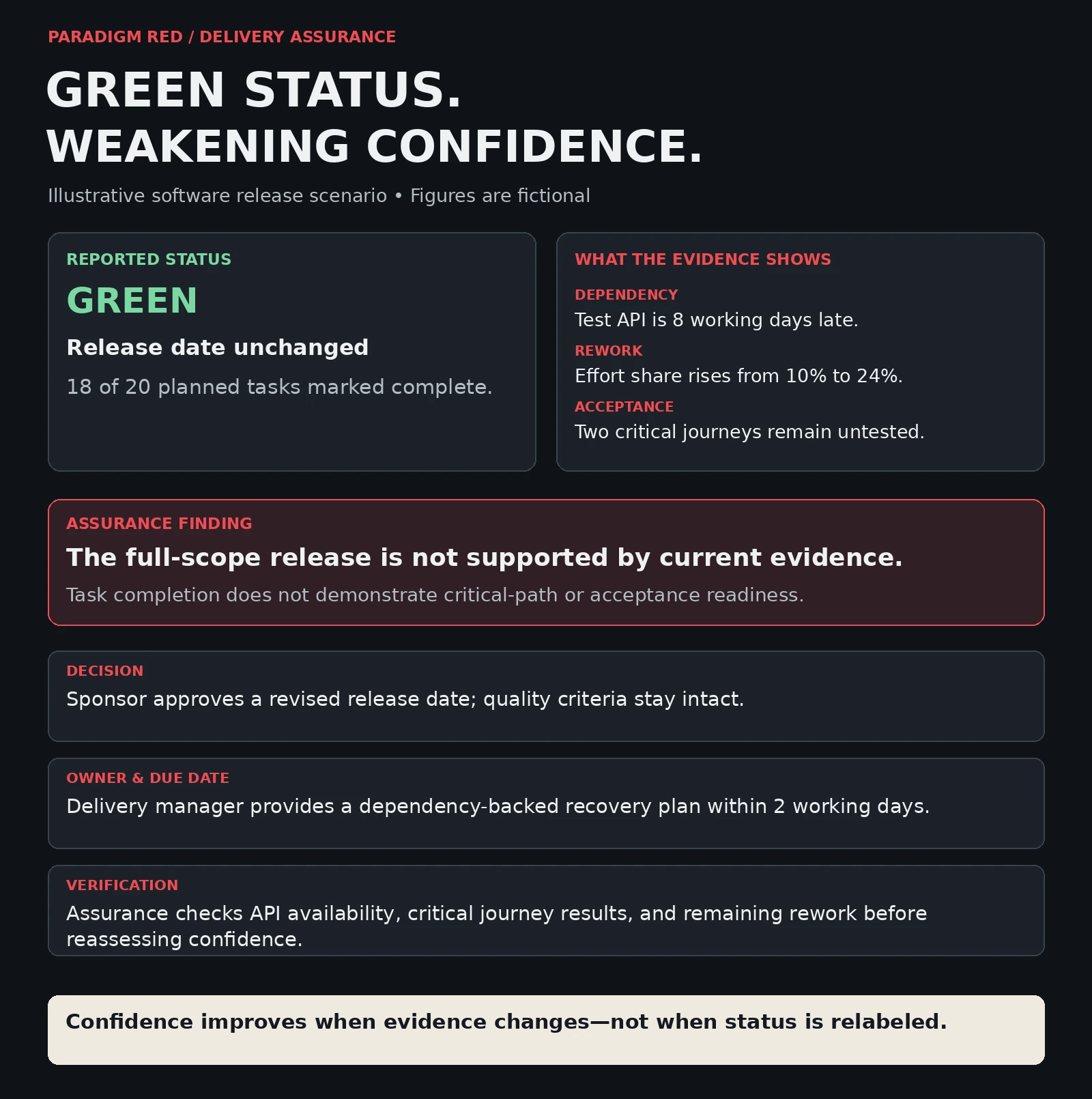
The review finds that the test API is eight working days late, correction effort has risen from 10% to 24% of total effort across two comparable reporting periods, and two critical journeys remain untested. The integration delay has consumed the planned acceptance window. The reviewer checks these findings against the supplier forecast, work records, and acceptance plan.
Finding: the full-scope release on the original date is not supported by current evidence. The dependency delay threatens acceptance readiness, while increased correction effort weakens the assumption that the team can recover the schedule without changing the plan. The percentages support investigation; they are not automatic red-status thresholds.
The sponsor compares a reduced-scope release with a revised date. In this example, the two journeys are essential to the agreed outcome, so the sponsor authorizes revising the date while preserving quality criteria. The delivery manager must produce a dependency-backed recovery plan within two working days; the revised date is confirmed through the agreed governance route once that plan is assessed.
Assurance then checks API availability, the revised sequence, critical-journey results, and remaining rework before reassessing confidence. The example stops at that verification requirement: approving a recovery plan does not prove recovery has occurred.
A copyable delivery assurance review template
Use one record per material finding. Retain enough context for someone outside the review to understand the concern and decision. Keep sensitive customer or personnel information in the appropriate controlled system.
DELIVERY ASSURANCE REVIEW

Commitment / outcome:
Scope, date, and acceptance criteria:
Review date and reviewer:
Evidence sources, dates, and owners:
Key assumptions and evidence gaps:
Finding and threatened commitment:
Confidence assessment and rationale:
Options and recommended response:
Authorized decision-maker and decision:
Action owner and due date:
Expected effect on delivery risk:
Verification evidence and review date:
Residual risk and escalation route:
Closure or reassessment rationale:
Separate the finding from the proposed solution. “Critical acceptance evidence is missing” is a finding; “delay release” is one possible response requiring the relevant authority. Preserve the original assessment and later updates so the record supports organizational memory rather than retrospectively rewriting what was known.
Common delivery assurance failures
- Reporting without intervention: the review identifies a threat but nobody can make the required decision. Establish authority and escalation before adding another dashboard.
- Assurance becomes delivery ownership: the reviewer designs, executes, and approves the same recovery. Separate responsibilities or disclose the limitation and arrange additional challenge.
- Stale or selective evidence: a reassuring narrative relies on old forecasts or excludes operational and customer voices. Date evidence and examine contradictions.
- Checklist completion replaces judgment: every field is filled while a critical assumption remains unsupported. Assess consequences, not just completeness.
- Bad news is punished: teams learn to protect status rather than expose risk. Evaluate the response to early warnings, including leadership behavior.
- Action closure replaces risk reduction: meetings and documents are completed without changing delivery conditions. Require verification of the intended effect.
How to introduce delivery assurance without unnecessary bureaucracy
Start with one delivery stream and a real upcoming commitment. A bounded pilot helps establish useful evidence and decision routes before scaling the process. The sequence below is illustrative, not a promise that assurance capability can be built to a fixed deadline.
- Agree the mandate: define scope, independence, access, accountability, and who receives findings.
- Establish a baseline: review the current commitment, acceptance criteria, forecasts, and material risks. Reuse existing evidence where credible.
- Run a focused review: apply the six assessment areas, document uncertainty, and agree a small number of consequential actions.
- Verify and improve: assess whether the review changed a decision or reduced exposure. Remove duplicate reporting and adjust depth to risk.
For a portfolio, coordinate this with existing governance and capacity planning. If assurance repeatedly finds that the same scarce people are committed to incompatible deadlines, escalating each project separately will not resolve the shared constraint. Examine change saturation and the allocation decisions sustaining it.
Five questions before you trust the delivery status

- What exactly are we committing to?
- What evidence supports that commitment?
- What could invalidate our confidence?
- What decision or action is needed now?
- How will we verify that the risk changed?
Frequently asked questions about delivery assurance
Is delivery assurance the same as project assurance?
The terms overlap. Project assurance commonly concerns confidence in a particular project; delivery assurance may be used across projects, programs, services, or technology delivery. Define the mandate rather than assuming every organization uses the labels identically.
Is delivery assurance the same as quality assurance?
No. Quality assurance focuses on confidence in quality processes and controls. Delivery assurance considers the broader credibility of commitments, including capacity, dependencies, outcomes, and financial exposure. Quality evidence is one input.
Who owns corrective action?
The delivery owner coordinates the response within delegated authority. Sponsors or governance bodies decide larger trade-offs. Assurance reviews the proposed response and verifies its effect; it should not absorb all delivery accountability.
How often should assurance reviews happen?
Match the cadence to risk, delivery pace, and decision points. Use additional reviews when material assumptions change. Critical concerns should be escalated promptly rather than held for a scheduled meeting.
Can delivery assurance guarantee on-time delivery?
No. Assessments depend on available evidence, assumptions, and changing conditions. Assurance makes uncertainty and risk more visible so authorized people can act; it cannot eliminate them.
What should a delivery assurance report include?
The commitment, evidence, assumptions, material findings, confidence rationale, required decisions, owners, dates, and verification criteria. A short report that enables action is more useful than a long report without accountability.
Use assurance to improve the conditions of delivery
Repeated delivery problems often reveal shared conditions: conflicting priorities, slow decisions, unrealistic capacity assumptions, or incentives that reward optimistic reporting. Assurance becomes more valuable when findings help leaders examine those conditions as well as individual project responses.
Sources and scope
- APM: What is governance? — authority, accountability, and assurance principles.
- APM Assurance SIG: Assurance Assessment Toolkit — a context-sensitive practitioner reference, not a certification standard.
- DORA: Software delivery performance metrics — the five current measures and interpretation guidance.
Sources checked 27 September 2026. The six-area framework, checklist, template, and fictional example are practical adaptations developed for this article.