A leader proposes a Friday launch. Nobody objects. The minutes record unanimous support. After the meeting, an engineer mentions that rollback has not been tested, while support quietly worries about weekend cover. The meeting produced agreement without bringing the relevant concerns into the decision.
Groupthink in the workplace occurs when pressure to preserve agreement discourages people from critically examining a proposal, sharing doubts, or considering alternatives. It can make a decision look more thoroughly supported than it actually is.
The practical response is to gather independent views, examine conflicting evidence, protect useful challenge, and record why a choice was made. This guide explains the signs, shows illustrative workplace examples, and provides a meeting protocol you can use immediately.


What is groupthink in the workplace?
Psychologist Irving Janis developed groupthink as an explanation of failures in group decision-making. The central concern is excessive pressure toward agreement. People may preserve the group’s preferred position even when a more careful examination would expose weaknesses.
A quiet meeting does not establish groupthink. Nor does a bad outcome: a careful decision can fail under uncertainty. Look at the process. Could people contribute independently? Was unwelcome evidence considered? Were alternatives compared? Could someone disagree without being treated as disloyal?
Groupthink is also different from deliberate consultation followed by a manager’s decision. A leader can hear objections and still choose another course. The important distinction is whether the objections received a fair examination and whether the decision’s authority was clear.
Groupthink vs healthy consensus and collective intelligence
Consensus describes agreement. Groupthink describes a failure in how a group examines a choice. A team can reach consensus after rigorous debate, and a divided team can still handle evidence poorly.

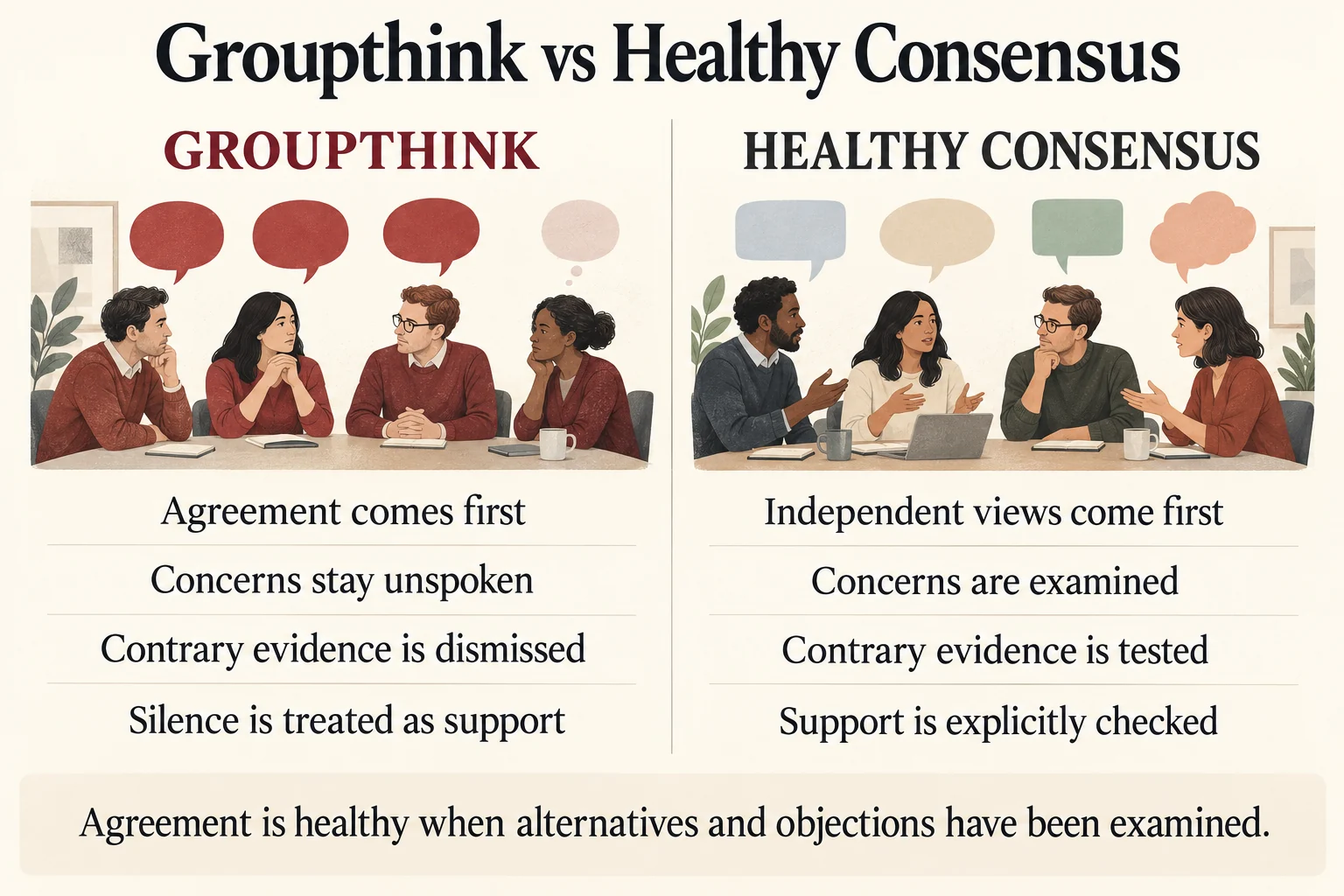
| Decision behaviour | Groupthink pattern | Healthy consensus |
|---|---|---|
| Initial views | People copy the apparent preferred answer. | Participants contribute judgments before convergence. |
| Objections | Concerns threaten belonging or status. | Concerns are examined on their merits. |
| Evidence | Contradictory facts are dismissed or filtered. | Evidence can change the proposal. |
| Closure | Silence is reported as support. | Support and remaining reservations are explicitly checked. |
Team cohesion means people feel connected; it does not tell you whether they test assumptions. Collective intelligence concerns the group’s ability to use what different people know. Independent contributions must be examined and integrated, rather than merely collected. See the broader guide to collective thinking for that distinction.
Eight signs of groupthink at work
The following are workplace translations of the classic symptoms associated with Janis’s model. They are warning signs to investigate, not a validated checklist for diagnosing a team. For the theory’s research context, see Esser’s review of groupthink research.

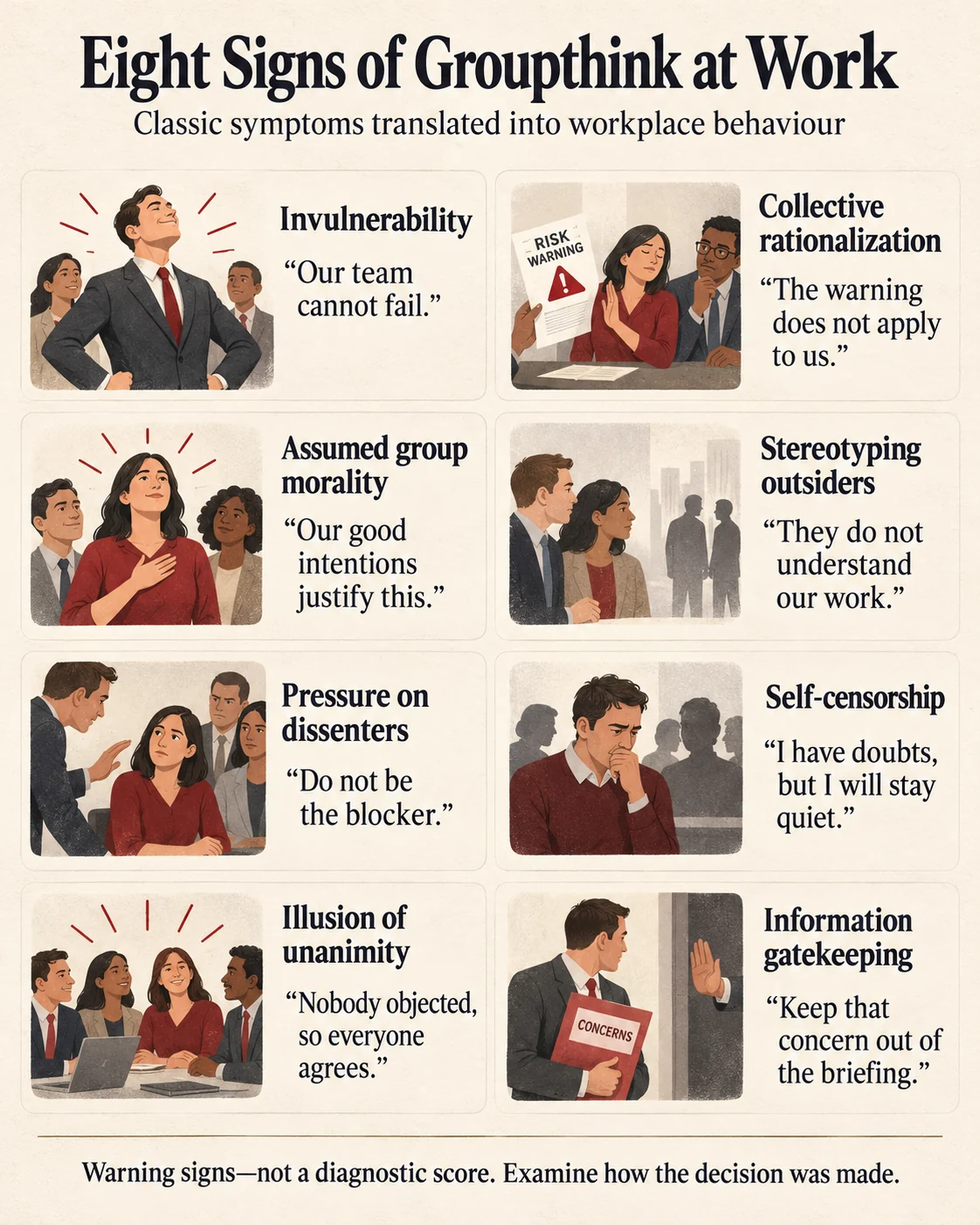
- Illusion of invulnerability: previous success becomes a reason to assume the team cannot fail.
- Collective rationalization: members explain away warnings instead of checking their implications.
- Assumed group morality: confidence in good intentions displaces scrutiny of consequences.
- Stereotyping outsiders: criticism is dismissed because of who raised it.
- Pressure on dissenters: a challenge is treated as obstruction or disloyalty.
- Self-censorship: people withhold doubts that conflict with the apparent preferred position.
- Illusion of unanimity: silence is taken as evidence that everyone agrees.
- Information gatekeeping: people shield the group from inconvenient information, sometimes called “mindguarding.”
Ask for a concrete incident before applying any label. Which concern was withheld? What happened when someone challenged the proposal? Was the information excluded because it was irrelevant, or because it was uncomfortable? The distinction matters.
What conditions encourage groupthink?
A systems perspective examines what makes silence easier than contribution. Inviting people to “be brave” will achieve little if previous dissent damaged their reputation or career prospects.
- Early leadership preferences: a senior person’s proposal becomes the answer others must either endorse or publicly resist.
- Costs of disagreement: people expect objections to be interpreted as negativity, lack of commitment, or personal criticism.
- Filtered information: briefings remove unresolved concerns to keep executive reporting simple or positive.
- Insulation: customers, operational teams, or relevant specialists cannot challenge assumptions before commitment.
- Pressure for rapid closure: a deadline becomes a reason to avoid examining the most consequential uncertainty.
These conditions do not prove groupthink. They identify where to inspect the decision process. Strong relationships and tight deadlines can coexist with thoughtful challenge when the meeting makes room for it.

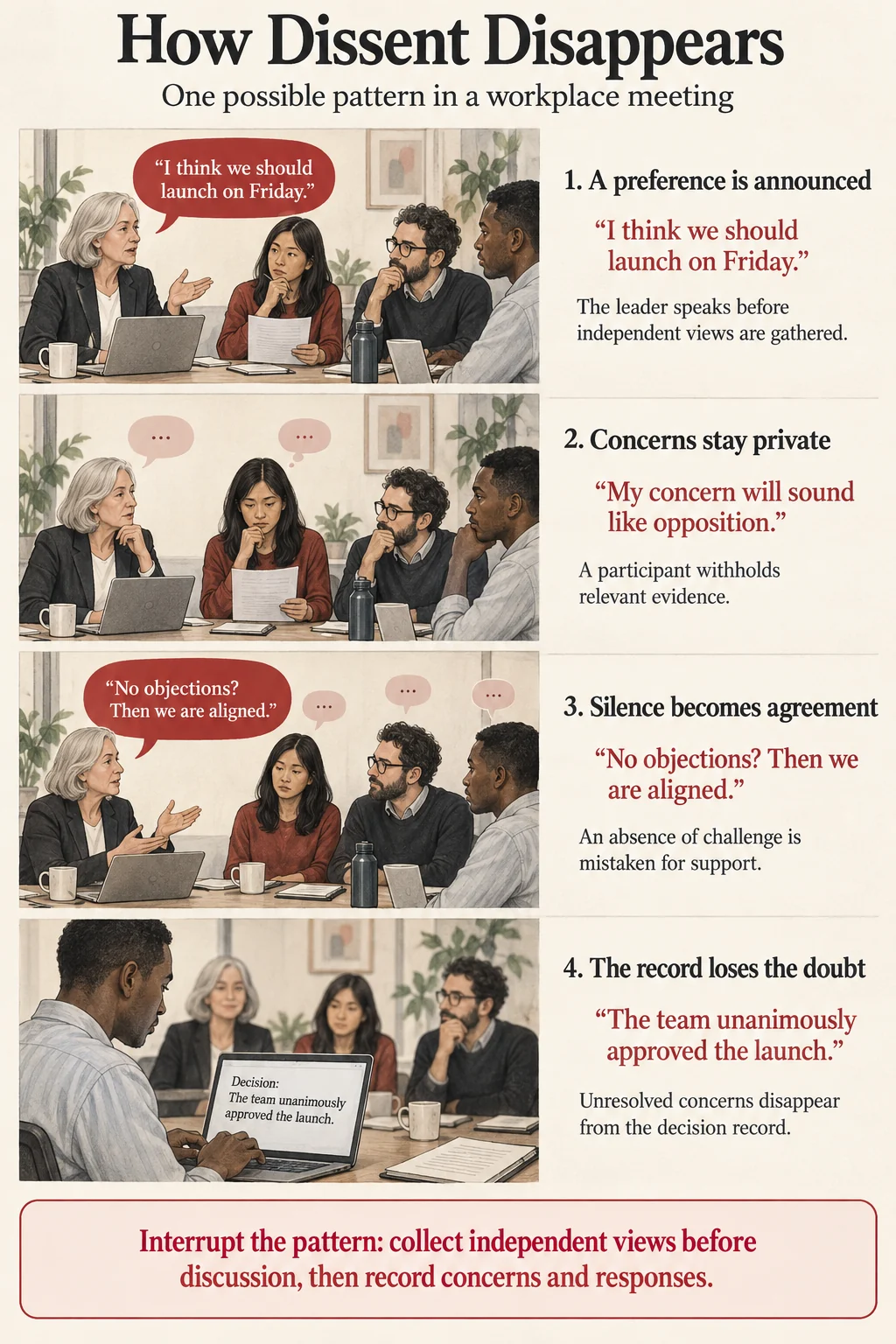
The resulting false harmony can conceal disagreement until implementation. A useful intervention changes the information available before commitment, rather than relying on someone to object after the organization has already announced the answer.
Three illustrative examples of groupthink in the workplace
These scenarios are fictional illustrations, not documented case studies. Each shows a process problem worth investigating.
1. A product launch becomes a loyalty test
The commercial lead promises a release date. During the readiness meeting, a tester is told that raising another issue would undermine the team. The tester softens a concern about a failed recovery scenario, and the group approves the launch without evaluating it. The warning sign is pressure to suppress relevant evidence, not simply the ambitious deadline.
Useful intervention: collect readiness evidence before discussion and require an explicit response to unresolved release risks.
2. A transformation steering committee protects its preferred programme
A sponsor describes a programme as essential to the organization’s identity. Evidence of low adoption is repeatedly attributed to employee attitude. An alternative proposal to change scope is excluded from the briefing because it would “confuse the message.”
Useful intervention: compare alternative explanations and options, including a smaller scope, against agreed evidence. Record what would invalidate the current approach.
3. An incident review settles too quickly on a familiar cause
The group accepts a senior specialist’s explanation before hearing from customer support. Support has observations inconsistent with that explanation, but the facilitator ends the discussion once the senior participants agree.
Useful intervention: separate observations from explanations and ask each relevant function what it knows that the others may not.
How to prevent groupthink before, during and after a meeting
The following protocol is a practical synthesis, not a guarantee. Adapt its depth to the decision’s consequences, uncertainty, urgency, and reversibility.

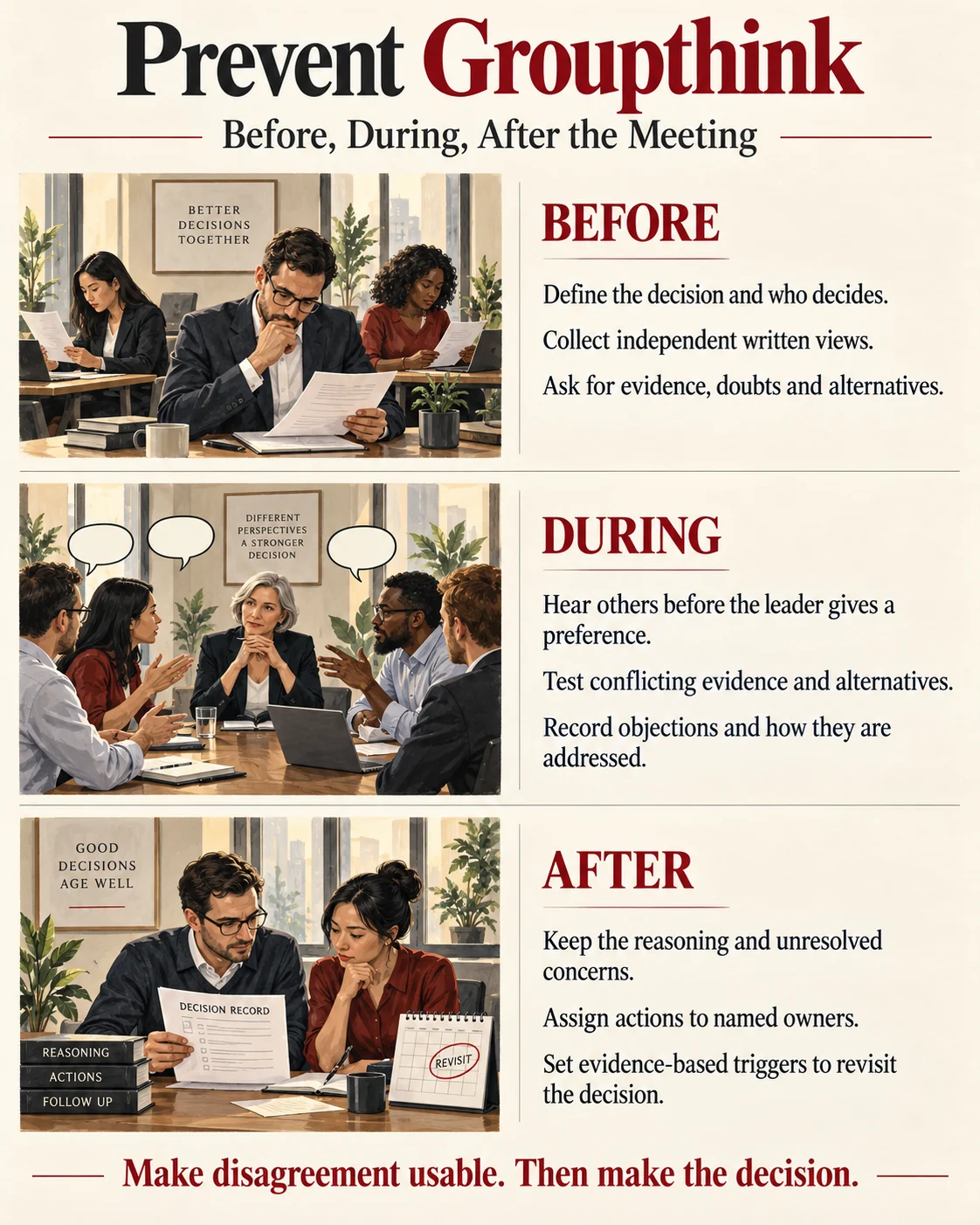
Before: protect independent judgment
Define the question and who decides. Is the group recommending, advising, voting, or making a joint commitment? Name the authority, deadline, constraints, and criteria. Ambiguous participation can create an appearance of shared approval that nobody actually intended.
Collect short written views before people see one another’s answers. Ask for a preferred option, supporting evidence, main uncertainty, and credible alternative. Independent input preserves a starting point; it does not mean everyone must remain attached to their initial opinion.
Include the people holding relevant evidence. Invite affected functions or request their observations in advance. A larger meeting is not automatically better. Participation should improve the information available.
During: examine concerns without losing the decision
Hear contributions before the leader announces a preference. The leader can still explain constraints and ultimately decide. The aim is to reduce pressure to align before participants have expressed their assessment.
Ask what would change the group’s mind. Separate evidence, interpretations, and preferences. A question such as “Which observation does this proposal fail to explain?” is more useful than demanding objections for their own sake.
Record concerns and responses. An objection can be resolved, accepted as a risk, assigned for investigation, or escalated. It should not disappear merely because the group runs out of time.
Close using an explicit rule. Challenge need not continue indefinitely. Establish what must be checked now, what can remain uncertain, and who can authorize the choice. The guide to collective decision-making explains the wider choice of decision rules.
After: preserve reasoning and review conditions
Keep a short record of the choice, alternatives, supporting evidence, unresolved concerns, action owners, and review triggers. Describe the actual decision: “Approved by the accountable owner after consultation” is different from “unanimously supported.”
Revisit the decision when the agreed evidence changes. Examine whether the team used available information responsibly, rather than judging its process solely from the outcome. Organizational memory improves when later teams can recover the reasoning behind earlier commitments.
Why a devil’s advocate is not enough
An assigned challenger can help examine assumptions, but the role may become a ritual everyone discounts. Real concerns must remain welcome from anyone. Anonymous input can surface sensitive issues, but it needs a credible route for follow-up and cannot replace accountability for how concerns are handled.
Psychological safety matters because people need to raise relevant concerns without interpersonal punishment. It works alongside evidence standards, clear authority, and an expectation that everyone’s reasoning can be questioned.
Worked example: changing a rollout decision
Illustrative scenario: a software team is considering a release to every customer on Friday. The original meeting ends without objections, but nobody has explicitly checked whether silence means agreement.

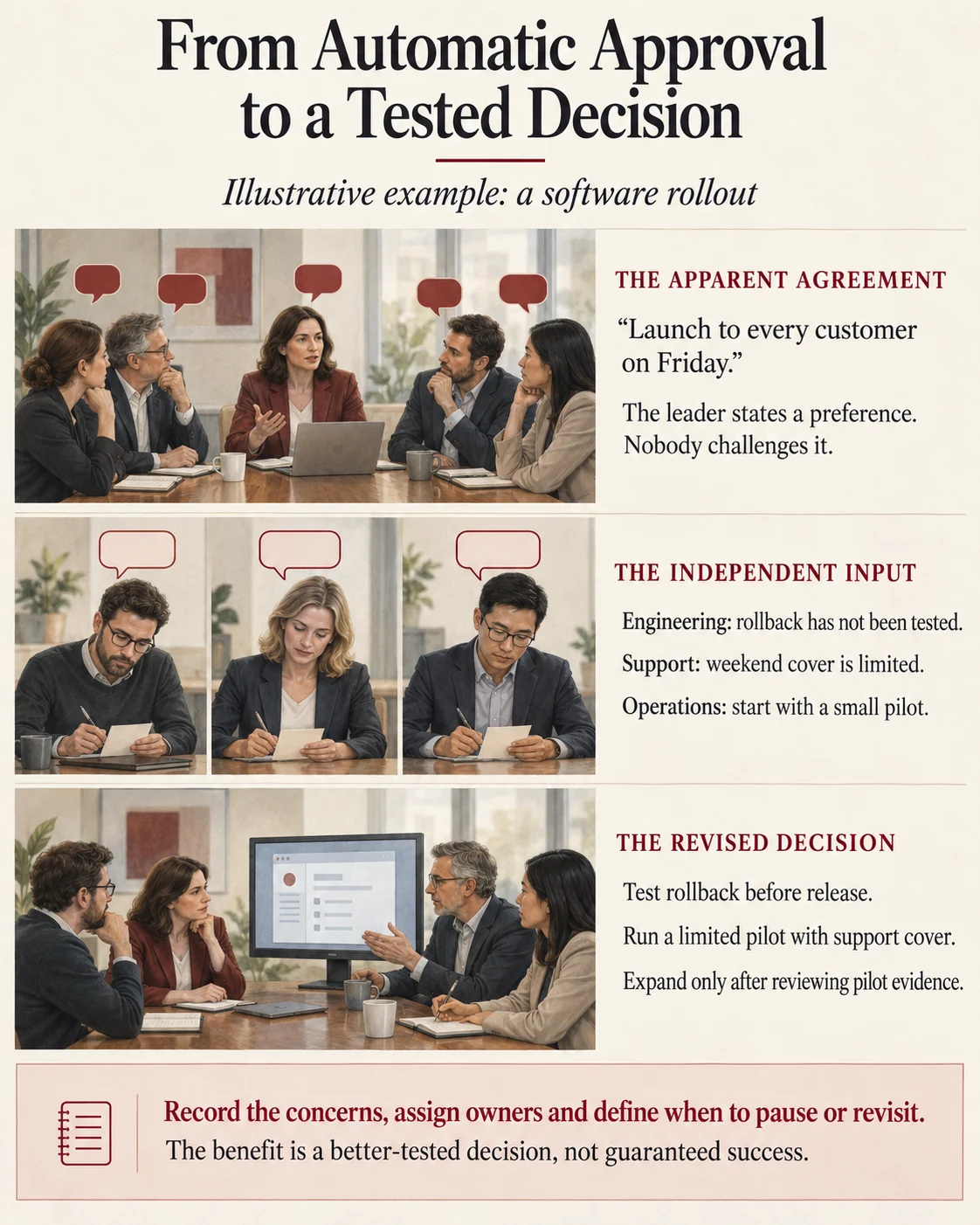
Before approval is finalized, the facilitator collects independent written assessments. Engineering reports that rollback is untested. Support identifies limited weekend cover. Operations proposes a small pilot. These are different contributions: two describe constraints, while the third offers an alternative.
The decision owner, Maya Chen, changes the proposal to a limited pilot with confirmed support cover, conditional on a successful rollback test. Wider release remains a separate decision. The following names, times and thresholds are fictional planning assumptions, not universal release standards. All times use the team’s local time zone.
| Concern or decision | Named owner and deadline | Acceptance or review condition |
|---|---|---|
| Untested rollback | Alex Morgan, engineering lead: complete and document the rehearsal by Thursday, 15:00. | Restore the previous version within 15 minutes in the test environment, with transaction reconciliation showing no missing or duplicate records. Maya withholds pilot approval if the test fails. |
| Limited support cover | Sam Rivera, support lead: confirm the staffed Friday 09:00–17:00 pilot window by Thursday, 16:00. | Identify a primary responder and backup, verify access, and test the escalation contact. Reschedule if either responder is unavailable. |
| Pilot scope and stop rule | Priya Shah, operations lead: confirm 20 opted-in customer accounts and monitoring by Friday, 08:30. | Pause the rollout for any data-integrity issue, any critical incident, or a failed-request rate above 1% over a rolling 15-minute window containing at least 100 requests. Alex executes rollback when required by the incident procedure. |
| Wider release | Maya Chen, decision owner: review the pilot with Alex, Sam and Priya on Monday, 10:00. | Require no unresolved critical incident or reconciliation discrepancy and at least 500 observed requests with a failed-request rate at or below 1%. If evidence volume is insufficient, extend observation with confirmed cover. Expansion requires a new explicit approval. |
The team selects its own thresholds before launch based on service commitments, baseline behaviour, risk and recovery capability. The 1% threshold in this example is illustrative; it is not a general recommendation. Sam’s concern about wider-release support remains open until Maya approves a separate coverage plan. The record therefore says “limited pilot approved with conditions,” not “everyone supports the full rollout.”
The example does not establish that the pilot will succeed. It shows a narrower claim: relevant information changes the choice, uncertainties become explicit, and responsibility for checking them becomes visible.
Five questions before approving a decision

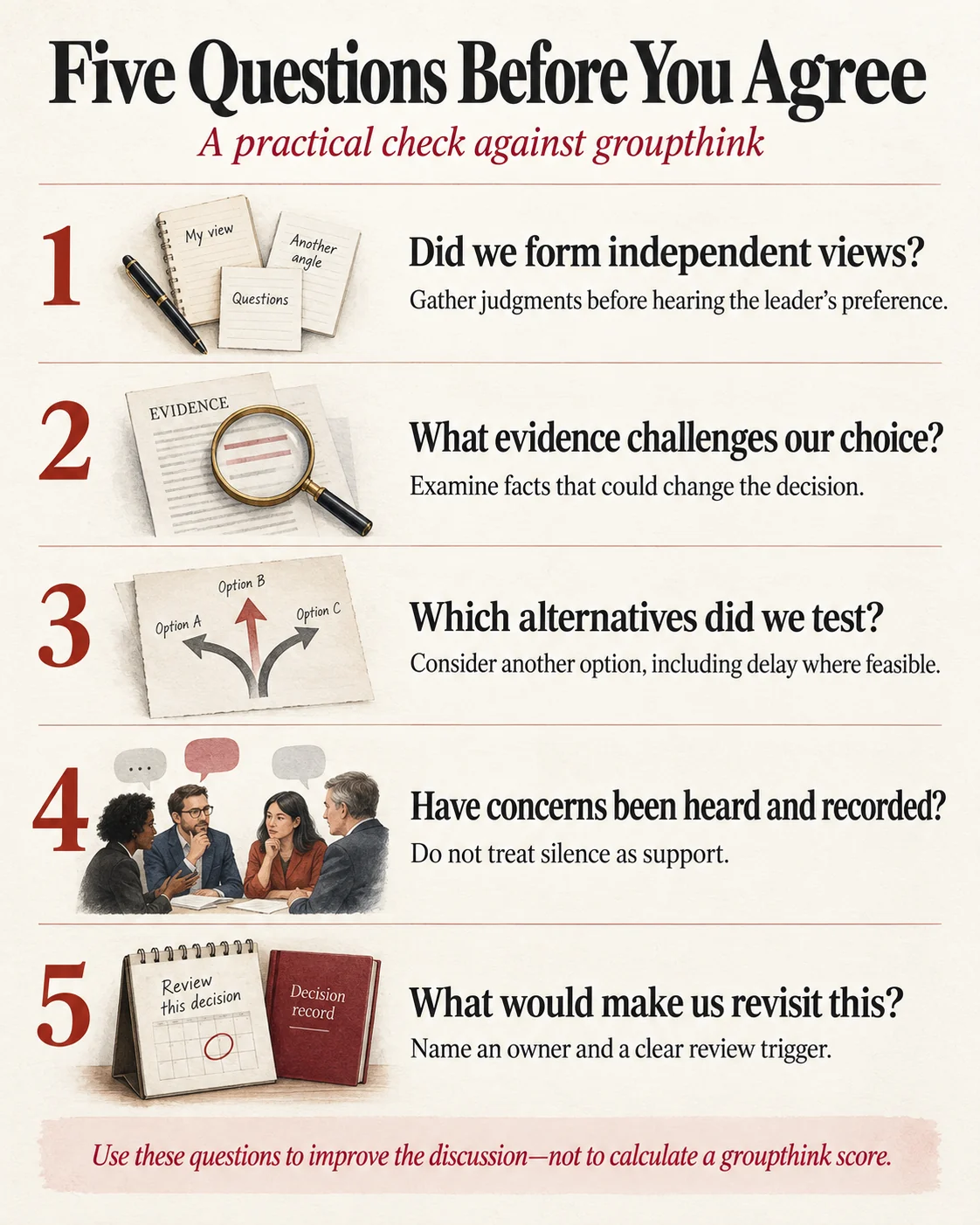
- Did we form independent views? Gather judgments before hearing the leader’s preference.
- What evidence challenges our choice? Examine facts that could change the decision.
- Which alternatives did we test? Consider another option, including delay where feasible.
- Have concerns been heard and recorded? Do not treat silence as support.
- What would make us revisit this? Name an owner and a clear review trigger.
Do not turn the answers into a groupthink score. If an answer is missing, identify the specific gap and decide whether it must be addressed before commitment. A question can improve a discussion without becoming a measurement instrument.
What the research supports—and what it does not
James Esser’s review of groupthink research examines historical case analyses and laboratory studies, and identifies theoretical and methodological questions. Groupthink is a useful lens for examining decisions, but a confident retrospective story is not the same as proof that one mechanism caused an outcome.
Related experimental work offers a narrower finding. In a study of 144 participants answering factual estimation questions, Lorenz and colleagues found that seeing other people’s estimates could reduce diversity and increase confidence without improving collective accuracy. This supports caution about premature convergence in estimation tasks. It does not establish that discussion is generally harmful or that every workplace team should decide independently. Read the original study.
The protocol here combines practical safeguards for collecting and examining information. It is not a tested intervention package with a claimed success rate. Use it to make the process inspectable, then evaluate whether relevant evidence is actually influencing your decisions.
Frequently asked questions
What is a simple example of groupthink at work?
A team endorses a leader’s launch proposal while members withhold known concerns because challenging it is treated as disloyal. Agreement alone is insufficient evidence; the suppression of relevant examination is the important feature.
Is all consensus groupthink?
No. People can independently assess evidence, challenge alternatives, and reach the same conclusion. Healthy consensus survives examination and can change when new information appears.
Can groupthink happen in remote teams?
Yes. A senior person’s message can establish the expected answer before others respond. Collecting views independently before sharing them, and explicitly checking reservations, can make remote discussions more informative.
What can I do if I am not the meeting leader?
State the decision-relevant concern concretely: “Before we approve, can we check this failed test?” Offer evidence and an alternative or next step. If the concern remains unresolved, ask for it to be recorded and use the appropriate escalation route for the decision.
How can a team disagree without slowing every decision?
Set a time limit, decision criteria, and authority in advance. Concentrate challenge on consequential assumptions. More reversible choices can use shorter reviews; consequential commitments may require additional evidence before approval.
Make the next meeting more informative
Choose one upcoming decision. Ask participants to submit their preferred option, main concern, and supporting evidence before the discussion. During the meeting, compare what differs. At closure, record which concerns changed the proposal, which remain, and what would reopen the choice.
That small change makes it easier to distinguish informed agreement from an agreement the meeting merely appeared to produce.