Tag: emergence
Emergence describes how patterns, behaviors, and outcomes arise from interactions within a system rather than from centralized control. In complex systems, what happens is not fully designed or predicted—it emerges from the relationships between elements.
In organizations, emergence explains why culture, performance, and behavior cannot be controlled directly. They develop through feedback loops, incentives, communication patterns, and the way decisions are made under real conditions.
On Paradigm Red, emergence is explored as a core principle of systems thinking and systemic transformation. Instead of trying to force outcomes, the focus shifts to shaping the conditions that allow desirable patterns to emerge.
Key aspects of emergence
- Outcomes arise from interaction, not individual intention
- Patterns cannot be fully predicted in advance
- Small changes can lead to large, system-wide effects
- Behavior stabilizes through feedback and reinforcement
Why emergence matters in organizations
- Explains why control-based leadership often fails
- Reveals how culture and behavior actually develop
- Shifts focus from managing people to shaping systems
- Supports better decisions in uncertainty and complexity
Related articles
-

What Is Collective Thinking? Meaning, Examples, and How Organizations Think Together
Collective thinking is how groups combine distributed knowledge and perspectives into shared understanding. Learn how the process works, how it differs from groupthink and collective intelligence,…
-

The Incentive Trap: Why Organizations Get Exactly What They Reward
Estimated reading time: 13 minutes Why do organizations reward collaboration but create silos? Why do leaders ask for innovation while punishing failure? Why do companies encourage…
-
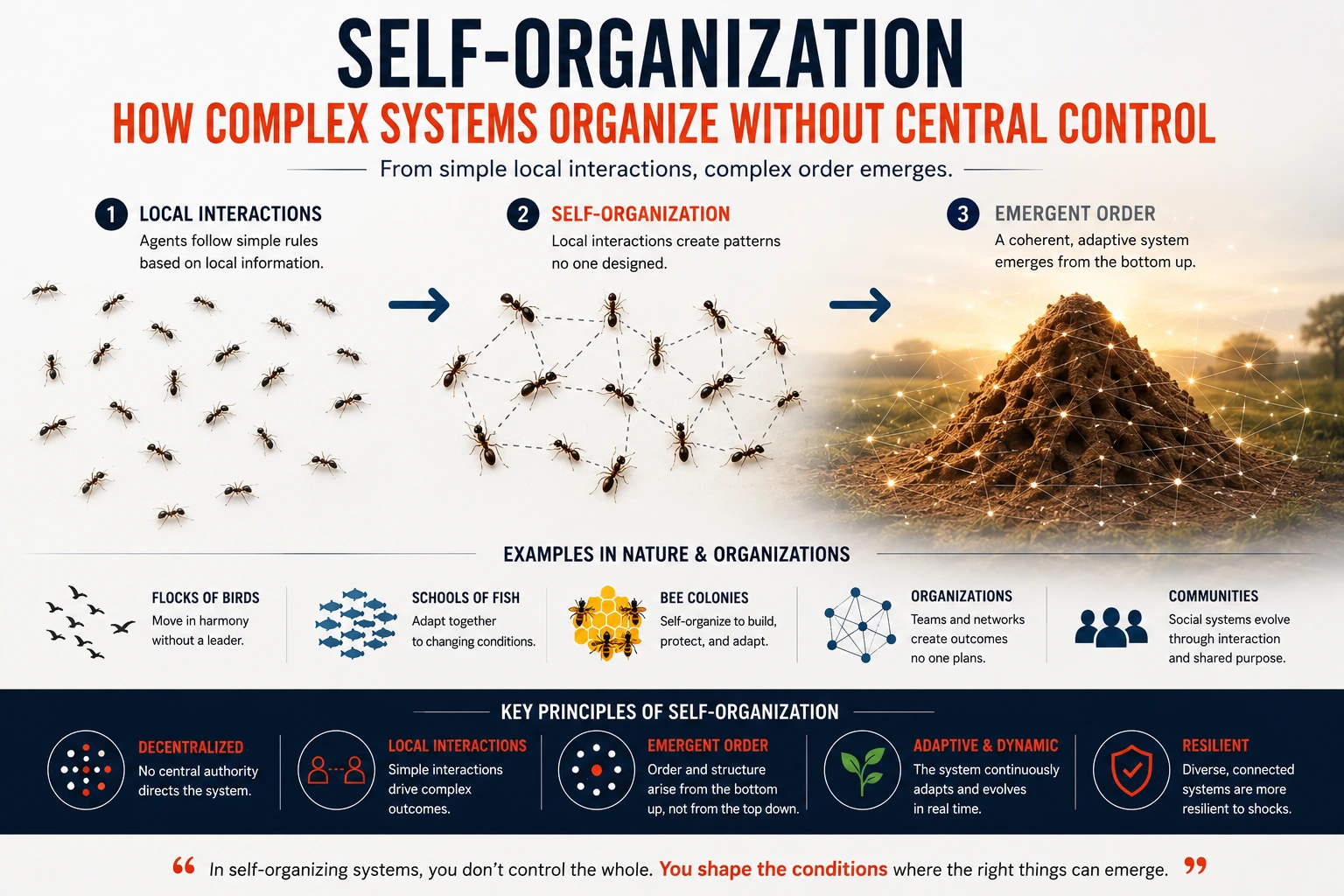
What Is Self-Organization? How Complex Systems Organize Without Central Control
Self-organization is one of the most important concepts in complexity science, systems thinking, organizational transformation, and System Shaping. It explains how order, structure, coordination, and collective…
-

What Is Emergence? Definition and Examples in Systems Thinking
Emergence is the appearance of system-level patterns, properties, or behavior through interactions among the system’s parts. The key is the interaction: examining each part separately does…
-

Collective Mind: Meaning, Examples, and How Groups Think Together
A collective mind is the capacity for coordinated thinking and action that develops when people connect their knowledge, attention, and judgment. In organizational use, the term…
-

Insight as Intervention: How Awareness Itself Transforms Systems
Insight as intervention in systems begins with a simple but radical idea: the way we see a system is never neutral. In complex organizations, perception is…
-

Evolutionary Intelligence: How Mature Systems Keep Learning from Themselves
Evolutionary intelligence in organizations is the ability of a system to learn from its own patterns, update how it operates, and evolve its structures, decisions, and…
-

Systemic Renewal: How Systems Rebuild Themselves After Collapse
Systemic renewal in organizations is the process by which a system rebuilds itself after collapse by reorganizing around new patterns of trust, meaning, and coherence. In…
-

The Absence That Rules: Why What Isn’t Said Shapes the System More Than What Is
Leaders spend hours drafting strategies, polishing speeches, and aligning messages. They believe organizations are built by what is declared. But here is the deeper truth: systems…
-

The Hidden Backbone: Why Culture Stabilizes Systems More Than Strategy
Walk into almost any boardroom during a crisis and you will hear the same instinctive response: “We need a better strategy.” Leadership becomes effective when it…