Tag: complex systems
Complex systems are systems in which outcomes emerge from interactions rather than from simple, linear cause-and-effect relationships. Organizations, cultures, and societies behave as complex systems—constantly evolving, adapting, and responding to internal and external pressures.
Control is limited. Actions do not produce predictable results, and small changes can create disproportionate effects. This is why traditional management approaches based on planning, optimization, and control often fail in dynamic environments.
On Paradigm Red, complex systems are explored through systems thinking, systemic coaching, and leadership under uncertainty. Instead of trying to control outcomes, the focus shifts to understanding patterns, feedback loops, and conditions that shape system behavior.
Key characteristics of complex systems
- Emergence: outcomes arise from interactions, not from individual parts
- Non-linearity: small inputs can produce large effects
- Adaptation: systems evolve in response to pressure and feedback
- Interdependence: elements influence each other continuously
Why it matters in organizations
- Explains why change initiatives often fail
- Shifts focus from control to influence
- Reveals hidden patterns and feedback loops
- Supports better decision-making under uncertainty
Related articles
-
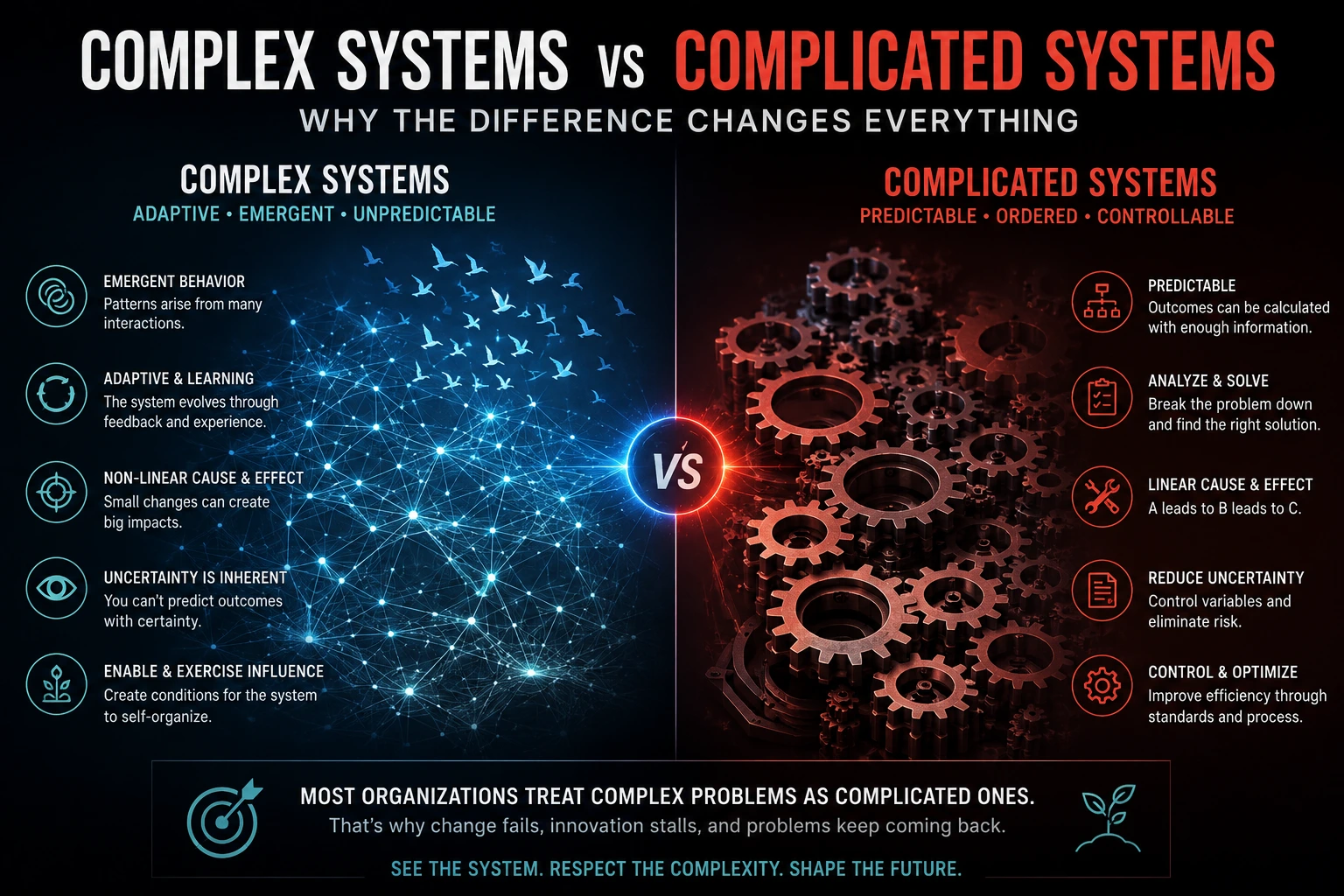
Complex Systems vs Complicated Systems: Why the Difference Changes Everything
One of the biggest mistakes in leadership, management, and organizational transformation is treating complex problems as if they were merely complicated. There is a difference between…
-

How to Read a System: A Practical Guide to Seeing What Actually Drives Behavior
Most people don’t know how to read a system clearly. They react to what happens instead of seeing what actually drives behavior. They respond to events,…
-

The Myth of Trade-Offs: Why Advanced Systems Don’t Choose — They Compound
For a long time, leadership has been taught as a series of trade-offs. Speed or quality. Growth or stability. Control or autonomy. Performance or well-being. Choose…
-
Collective Mind: Meaning, Examples, and How Groups Think Together
Collective mind meaning, in simple terms, is the shared capacity of a group to perceive, interpret, think, remember, and act through coordinated interaction. A collective mind…
-

Evolutionary Intelligence: How Mature Systems Keep Learning from Themselves
Evolutionary intelligence in organizations is the ability of a system to learn from its own patterns, update how it operates, and evolve its structures, decisions, and…
-
The Observer Effect in Organizations: How Reflection Shapes the System
Physics taught us something unsettling: the act of observing changes what is observed. Organizations are no different. What leaders watch, measure, and reflect on does not…
-
The Edge of Complexity: Why Systems Fail When Leaders Treat Complex Problems as Complicated
Leaders love solving problems. It is what they are rewarded for. Find the issue, apply expertise, push harder — and the system delivers. That logic works…
-
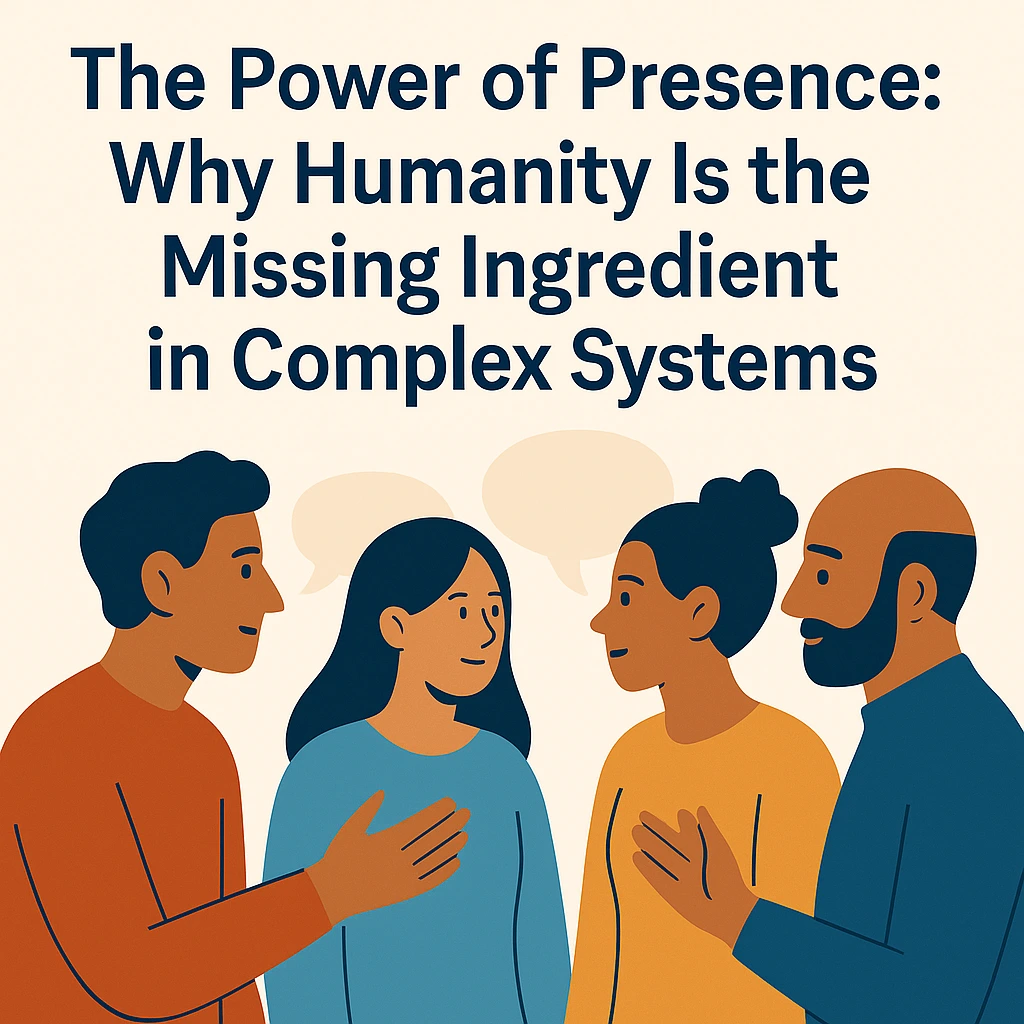
The Power of Presence: Why Humanity Is the Missing Ingredient in Complex Systems
In the world of systems thinking and organizational transformation, we often overlook humanity in complex systems — the one variable no model can fully capture. We…